Words by ITV News Producer Hannah Ward-Glenton
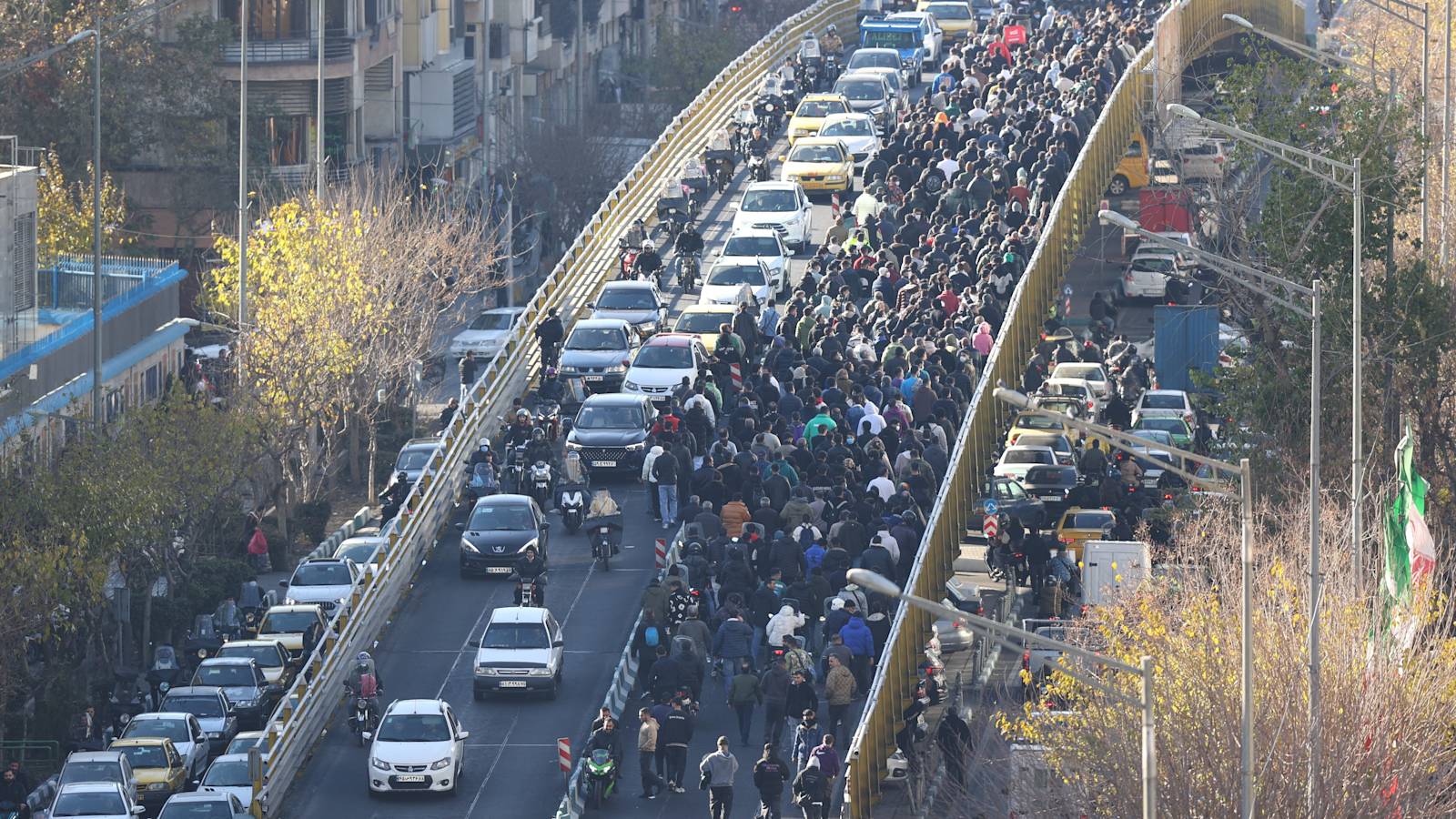
Demonstrations in Iran have spiralled into nationwide protests in recent weeks, and much of the country has been plunged into an internet blackout as the government tries to regain control.
So why are people protesting and how are the UK and US involved? ITV News explains.
Why did people start protesting?
On December 28, protests first broke out in two major markets in Iran’s capital Tehran.
This first wave of protests came after the Iranian rial (IRR) plunged to 1.42 million to the US dollar, having seen significant drops in value since it was pegged at 32.25 IRR to the dollar in 1945.
It was a new record low and worsened inflationary pressures, pushing up the price of food and other daily necessities.
Iran has also faced significant sanctions from the US, Europe and the United Nations in recent years, which have also made the cost of living more challenging for Iranians.
The government had already increased prices for nationally subsidised fuel in December, and the financial issues exacerbated already-simmering unhappiness over how Iran is run.
On December 29 and 30, protests had spread within Tehran, as well as to other cities and universities. Police began to use tear gas to try and disperse crowds in the capital.
By January 2, protests had expanded to reach more than 100 locations in 22 of Iran’s 31 provinces, according to the US-based Human Rights Activists News Agency.
Protests continued through to January 9, with online videos shared by activists purported to show protestors chanting against Iran’s government as bonfires and debris littered the streets of the capital, Tehran, and other cities.
Did the protests become violent?
On January 1 the first fatalities were reported, with authorities saying that at least seven people had been killed.
The most intense violence appeared to be in Azna, a city in Iran’s Lorestan province, where videos posted online seem to show objects in the street ablaze and gunfire.
In total, the US-based Human Rights Activists News Agency has estimated at least 65 people killed and over 2,300 others detained since the protests began.
What’s the historical context?
In 1953, US and UK governments worked with Islamist forces in Iran to overthrow its elected government and instead allow the country to be run as an autocracy under the Shah, the Iranian title of former monarchs.
At the time, the Shah was Mohammad Reza Pahlavi, who had purchased American military weapons and allowed CIA technicians to run secret listening posts monitoring nearby Soviet Union activity.
But in 1979 there were mass demonstrations against Pahlavi’s rule, and he fled. The Islamic Revolution, led by Ayatollah Ruhollah Khomeini, caused the pro-Western set-up to be overthrown and Iran’s current theocratic government to be instated.
Crown Prince Reza Pahlavi, the son of Mohammad Reza Pahlavi, declared himself Shah of Iran when his father died in 1980, but the US said at the time it did not support him as the leader of Iran.
In the decades that followed Pahlavi developed close ties to pro-monarchy group, and has campaigned for political change in Iran and has been planning his return to lead the country.
While many Iranians were happy to see Mohammad Reza Pahlavi overthrown, there has been growing discontent over Iran’s Islamic Republic government, leading to a bump in Crown Prince Reza Pahlavi’s popularity.
How did protests become so widespread?
The crown prince has played a key role in the protests becoming more widespread.
Crown Prince Pahlavi called for protests on Thursday night, and thousands of people appeared on the streets, with chants including “Death to the dictator!” and “This is the last battle! Pahlavi will return!”
The internet and international phone lines were then cut off on Thursday night but protests continued into early Friday.
Pahlavi has called for more protests at 8pm on Friday and has asked for European leaders to join US President Donald Trump in promising to “hold the regime to account”.
“Per social media posts, it became clear that Iranians had delivered and were taking the call seriously to protest in order to oust the Islamic Republic,” Holly Dagres, a senior fellow at the Washington Institute for Near East Policy said.
“This is exactly why the internet was shut down: to prevent the world from seeing the protests. Unfortunately, it also likely provided cover for security forces to kill protesters.”
It is difficult to determine the full scale of the protests because of the blackout.
How has the Iranian government reacted?
Iran signalled on Friday that security forces would crack down on protestors. In footage aired by Iranian state television, Supreme Leader Ayatollah Ali Khamenei repeatedly referred to demonstrators as “terrorists”, setting the stage for a violent crackdown like those that followed other nationwide protests in recent years.
Iranian authorities have made multiple similar promises in recent days.
On January 3, Khamenei said “rioters must be put in their place,” in what was seen as a green light for security forces to begin tackling demonstrations more aggressively.
On Thursday, Khamenei signalled that authorities would crack down on demonstrators in a brief address aired by state television, as an audience shouted: “Death to America!”
Protesters are “ruining their own streets to make the president of another country happy”, Khamenei said, referring to US President Donald Trump.
Iran’s army chief also threatened preemptive military action over “rhetoric” targeting the Islamic Republic on Wednesday.
Central Bank head Mohammad Reza Farzin resigned in response to the protests and Abdolnasser Hemmati took over the role.
How have world leaders reacted?
Donald Trump weighed in on the protests on January 2, writing that if Iran “violently kills peaceful protesters” the United States “will come to their rescue” on his platform Truth Social.
The warning came only months after American forces bombed Iranian nuclear sites.
“We are locked and loaded and ready to go,” Trump added, without giving further details.
He has since reiterated this warning to Iran, saying the country is in “big trouble”, and if “they start killing people like they have in the past, we will get involved.”
On Friday, Supreme Leader Ayatollah Ali Khamenei dismissed Trump as having hands “stained with the blood of Iranians”, as supporters shouted “Death to America!” in footage aired by Iranian state television.
Pahlavi expressed his gratitude to Donald Trump in a post on X: “I want to thank the leader of the free world, President Trump, for reiterating his promise to hold the regime to account.”
He also called for Trump to be “prepared to intervene to help the people of Iran.”
On Friday, Prime Minister Keir Starmer condemned the killing of protesters in Iran and urged Tehran to “exercise restraint”.
In a joint statement with the leaders of France and Germany, he said he was “deeply concerned about reports of violence by Iranian security forces” and “strongly” condemned the killing of protesters.
Israel is closely monitoring the situation in Iran but Prime Minister Benjamin Netanyahu has reportedly instructed cabinet ministers to refrain from commenting.
“From Israel’s viewpoint, this is not the right time to intervene,” a former senior Israeli official told ITV News’ US partner CNN.
Follow STV News on WhatsApp
Scan the QR code on your mobile device for all the latest news from around the country