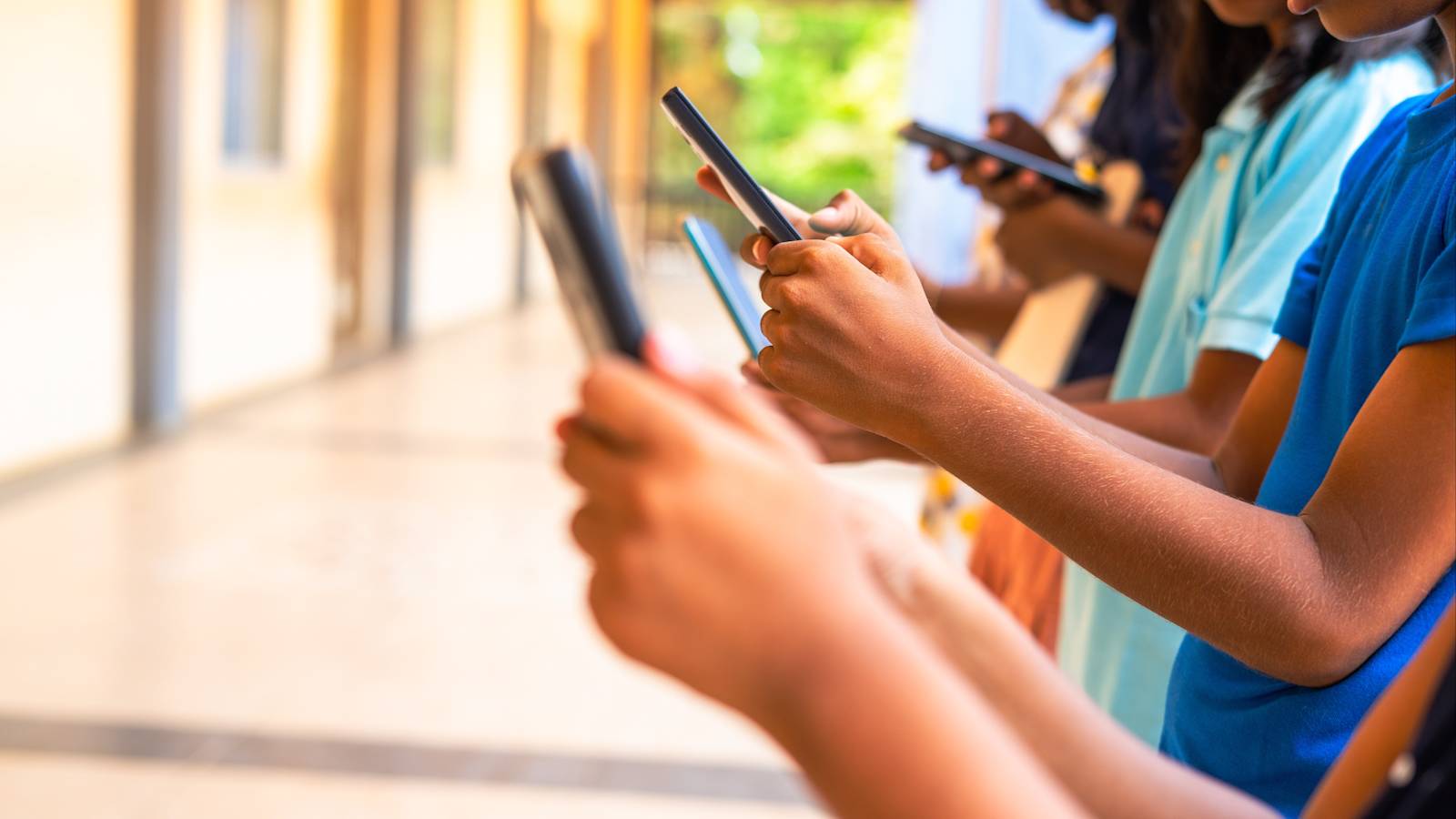
France has become the first European country to ban social media for children after Australia sparked a wave of legislative interest in the move last year.
Australia implemented restrictions on TikTok, Instagram, Facebook, X, Snapchat, YouTube, Kick, Twitch, Threads, and Reddit in December.
The rule change caused huge controversy, with strong voices both for and against the law. But now, other countries are following suit.
So what countries are looking to copy Australia and France, and how will they implement their own bans? ITV News explains.
Greece
Greek Prime Minister Kyriakos Mitsotakis announced plans for a total social media ban for children 15 and under on April 8, making it the latest European country to follow in Australia’s footsteps.
The new law targets social media platforms and puts the onus on them to prevent children from keeping or making user profiles. Penalties for failing to comply include fines of up to 6% of the company’s global turnover or restrictions on operations.
Mitsotakis said the move was to tackle social media addiction and anxieties in children, and to protect them from harm.
The law is expected to be introduced this summer and will come into force from January 1 next year.
Austria
Austria’s coalition government announced plans to ban social media use for children under 14 in late March.
It is not yet clear how the ban will work or when it will be imposed, with draft legislation expected to be finalised this summer. It will also require parliamentary approval.
Vice Chancellor Andreas Babler said the government would no longer “look on” as social media platforms “make our children addicted and often also sick”.
Additional lessons in schools will accompany the ban on how to use media and deal with artificial intelligence.
Spain
Spain’s prime minister said in February that his government plans to ban social media for people under 16.
Pedro Sánchez said the move is designed to shield young people from the harms of online content.
“Today, our children are exposed to a space they were never meant to navigate alone,” Sánchez said. “We will no longer accept that,” he said at a summit in the United Arab Emirates.
Sanchez said Spain has joined five other European countries – known as the “Coalition of the Digitally Willing” – to coordinate and enforce cross-border regulation of the new rules.
France
In July, lawmakers approved a bill banning social media for children under 15.
French President Emmanuel Macron has asked for the legislation to be fast-tracked, so that it could be in place by the start of the next school year in September.
“France is leading the way in Europe in protecting our children and our teenagers,” Macron said. “We will keep on going.”
It would also ban the use of mobile phones in high schools.
According to France’s health watchdog, one in two teenagers spends between two and five hours a day on a smartphone.
Denmark
Denmark announced in October that it would be moving towards banning social media for users under 15.
Prime Minister Mette Frederiksen said at the time that social platforms were “stealing our children’s childhood”.
Speaking at the opening of the Danish parliament, Frederiksen said her government would propose a ban that also gives parents the option to approve social media use from age 13.
“We have said yes to mobile phones in our children’s lives in the best sense. So they can call home and communicate with their friends,” she said.
“But the reality is that we have let a monster loose. Never before have so many children and young people suffered from anxiety and depression,” Frederiksen added.
Canada
Canada has introduced legislation that could bar children younger than 16 from having social media accounts unless the companies show they can make their platforms safe.
“We are failing our children. Enough is enough,” Marc Miller, Canada’s culture minister, said. “We need basic protection in place.”
The legislation covers seven types of harmful content including content that induces children to harm themselves, content that incites violence and foments hatred and non-consensual intimate images.
A new regulator, the Digital Safety Commission of Canada, will be created as part of the plans. Miller said platforms will need to prove they are safe and age verification measures will also be introduced.
Norway
Norway’s Prime Minister Jonas Gahr Støre has also proposed a ban for users under 15 years of age and his government launched a public consultation for a new law in June.
“This is one of the most pressing social and cultural challenges of our time, and it cannot be solved through national measures alone. We aim to strengthen European cooperation to ensure a safe digital environment for children and young people,” Støre said last year.
Alongside the ban, Norway has said it would issue national recommendations on screen times and remove mobile phones from schools through national recommendations.
UK
UK ministers launched a consultation on whether to ban under-16s from social media platforms earlier this year.
Overnight curfews, breaks to prevent “doom-scrolling”, and introducing an which would raise the digital age of consent, are some of the proposals the government is considering.
ITV News understands at least 66 Labour MPs want the government to bring in a social media ban for under-16s.
They raised concerns around teenagers’ rising mental health issues, their inability to focus on learning, and that they are “not building the social skills needed to thrive”, adding that the average 12-year-old spends 29 hours per week on a smartphone.
While the government is so far yet to introduce a ban, in June, former Prime Minister Kier Starmer announced that big tech companies including Google and Apple must introduce controls to “prevent children from sending and receiving sexually explicit images” – giving them three months to comply with the law.
In an interview with ITV News former Safeguarding Minister Jess Phillips, who quit cabinet in May over a lack of progress by the government on social media protections, said the “the writing is on the wall” for a social media ban for minors.
Prime Minister Andy Burnham has previously spoken in favour of the measure but has not commented on it since he came to office.

Brazil
A new law to protect children from addictive and harmful content online came into effect in Brazil in March.
Children under 16 are now required to link their social media accounts to a legal guardian to ensure supervision. The legislation also prohibits platforms from using addictive features such as infinite scroll and the automatic play of videos.
Digital services also must implement an effective age verification mechanism that goes beyond self-declaration that the user is over 18 to protect them from accessing inappropriate or prohibited material.
Indonesia
In March Indonesia became the first country in Southeast Asia to ban children from having accounts on YouTube, TikTok, Facebook, Instagram, Threads, X, Bigo Live and Roblox with new legislation.
The legislation bans children under 16 from accessing digital platforms that could expose them to pornography, cyberbullying, online scams and addiction.
“The government has instructed all digital platforms operating in Indonesia to immediately bring their products, features and services into compliance with applicable regulations,” said Indonesia’s Communication and Digital Affairs Minister Meutya Hafid.
“There will be no compromise on compliance, and every business entity operating in Indonesia is required to comply with Indonesian law.”
How have social media companies responded?
Meta, the parent company of Instagram, Facebook, and Threads, started rolling out its plan to ban young people from its platforms in the run-up to Australia’s ban.
Users aged 13 to 15 were notified that their access to those sites would be limited from December 4, with all users impacted by the law to be removed before it took effect on December 10.
But Meta Managing Director William Easton made it clear that the method would not be the company’s preferred way of protecting young people.
“We’re committed to meeting our compliance obligations and are taking the necessary steps to comply with the law. That said, we hope to continue engaging constructively with the Australian government to find a better way forward,” he said.
Snapchat and TikTok similarly deactivated accounts of people under 16 and placed age restrictions on creating new accounts.
Reddit launched a legal challenge against Australia’s ban, saying that it isolates teens “from the ability to engage in age-appropriate community experiences”.
The platform complied with the ban but challenged the law over concerns about privacy and political rights, and argued that the new law fails to protect children online.
X, meanwhile, said it had “serious concerns” around the “lawfulness” of the minimum age for social media.
“We are especially concerned about the potential negative impact that the Social Media Minimum Age will have on the human rights of children and young people,” it said in September.
YouTube described Australia’s ban as “disappointing” and said the law “will not fulfill its promise to make kids safer online”. It said the law would in fact “make Australian kids less safe on YouTube”.
Follow STV News on WhatsApp
Scan the QR code on your mobile device for all the latest news from around the country