
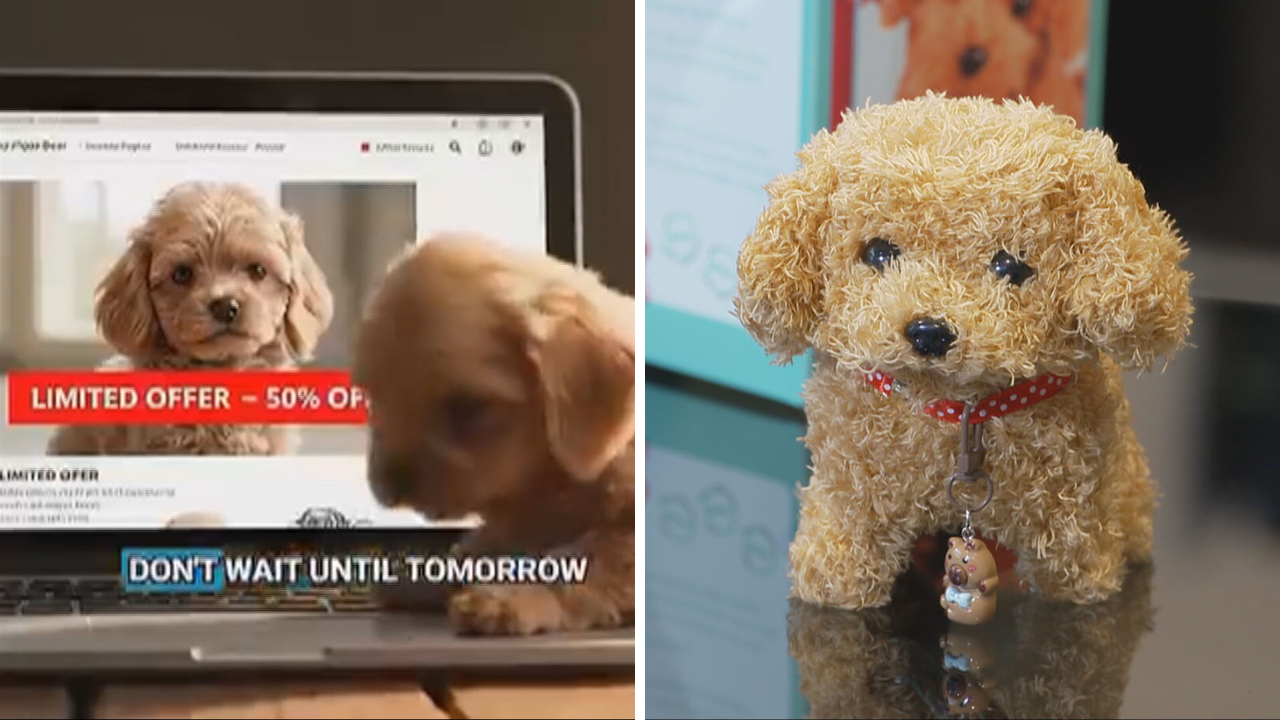
An AI video advert for a “smart robotic puppy” which claims to be capable of sitting on command and responding to its owner’s voice has been ruled “misleading” by the advertising watchdog.
ITV News has uncovered a number of similar social media posts for different products, which use elaborate AI videos and pictures promising high quality items – only for the real thing to look very different.
We found AI-generated images and videos on social media promoting the product, known online as “Wuffy”, “Wiggy” or “Waggy”, all promising a high-tech toy which behaves like a real dog.
Have you been caught out by misleading AI adverts?
Tell us your story.
The videos use AI animation to give the toy a realistic look, with one video showing the toy walking out of the packaging with the kind of motion you’d associate with a real puppy.
But customers have been left disappointed when what arrives turns out to be a cheap toy – with none of the advanced features promised by the videos online.
Laura Merriman, from Rhondda Cynon Taff, ordered two Wuffy dogs priced at £12.99 from TikTok Shop after seeing an video advert on the app.

“They were advertising these robotic dogs walking, barking at the kids, interacting with them. I thought, these are perfect, this is exactly what I want,” she said.
When the products arrived, she was shocked by the reality.
“They were not even the same colour, not the same shape, everything was completely different,” she said. “It was very disappointing. These weren’t the AI robotic dogs that I thought they could have been.”
After finding a number of complaints about the quality of the product online, we bought it from TikTok Shop – and found out for ourselves why customers felt so let down.
Wuffy didn’t behave like a real puppy, or respond to voice commands. All it could do was move backwards and forwards, and squeak.
Laura was refunded, but ITV News has spoken to customers who bought the product from different websites who are still trying to get their money back.

The Wuffy video banned by the Advertising Standards Authority (ASA) was a paid-for advert hosted on Facebook, after a number of complaints triggered an investigation.
Jessica Tye, Regulatory Projects Manager at the ASA, told us: “The company was advertising this product in a way that was completely misleading to people, and it’s understandable that people who bought this toy were hugely disappointed.”
AI is being used in advertising by a number of well-established brands, as the software can be used to enhance backgrounds and create artificial fashion models.
Have you been caught out by misleading AI adverts?
Tell us your story.
But developments in AI are making it harder for consumers to spot that the technology has been used at all – and are making it easier for misleading content to be created.
The CAP code followed by the ASA contains no specific regulation on the use of AI in adverts, and there is no requirement for advertisers to disclose when AI has been used.
But the code does state that whether AI is used or not, adverts cannot be misleading about what a product looks like, or its features.
Social media companies like Meta and TikTok have their own self-imposed rules about labelling AI content online.
TikTok requires all AI content to be labelled. Meta uses tools to detect where AI has been used and requires labelling of some content.
When asked whether using AI on adverts for products should be more tightly regulated, Jessica said: “Our codes are really clear that ads must not mislead, and we find that principle-based approach is really effective because it means we can be really flexible when new technology emerges.
“This investigation demonstrates that our existing rules are fit for purpose. We don’t need AI-specific rules to find that these ads were misleading and in breach, but we are producing new guidance all the time to address new techniques being used.”
Tracy Ives, from Suffolk, believes social media companies need to do more to tackle the use of AI in content used to promote products online, after being duped by an AI image of a lamp.
She bought what she thought was a hand-made stained glass lamp from a small business based in Cambridge – only to receive a substandard version of the product which looked very different when it arrived.
When she complained to the retailer, she was reassured the item was handmade, and offered 15% off her next order.
The advert has since been removed from Facebook – but Tracy said it has had a lasting impact.
“I don’t trust a lot of things I see on the internet now,” she said. “I think AI can be very dangerous, it’s only going to get worse.”
She told us social media platforms need to do more to crack down on AI content which misleads customers about items for sale online.

“They’ve got responsibility as they let the businesses advertise on their platform, so they need to do more,” she said.
A spokesperson for Meta said: “We don’t allow ads that use deceptive or misleading practices and have removed this advertiser from our platforms for violating our Advertising Standards, which apply to all ads on our platforms regardless of whether they feature AI-generated content or not.”
Meta has removed the advertiser and associated content from Facebook.
According to TikTok, sellers on TikTok Shop are provided with guidance to avoid the inappropriate use of AI, and all AI content on the platform must be labelled.
The platform had previously removed the listing for the Wuffy products ordered by ITV News.
ITV News has reached out to the company behind the Wuffy product but has not received a response.
Have you been caught out by misleading AI adverts?
Tell us your story.
Follow STV News on WhatsApp
Scan the QR code on your mobile device for all the latest news from around the country