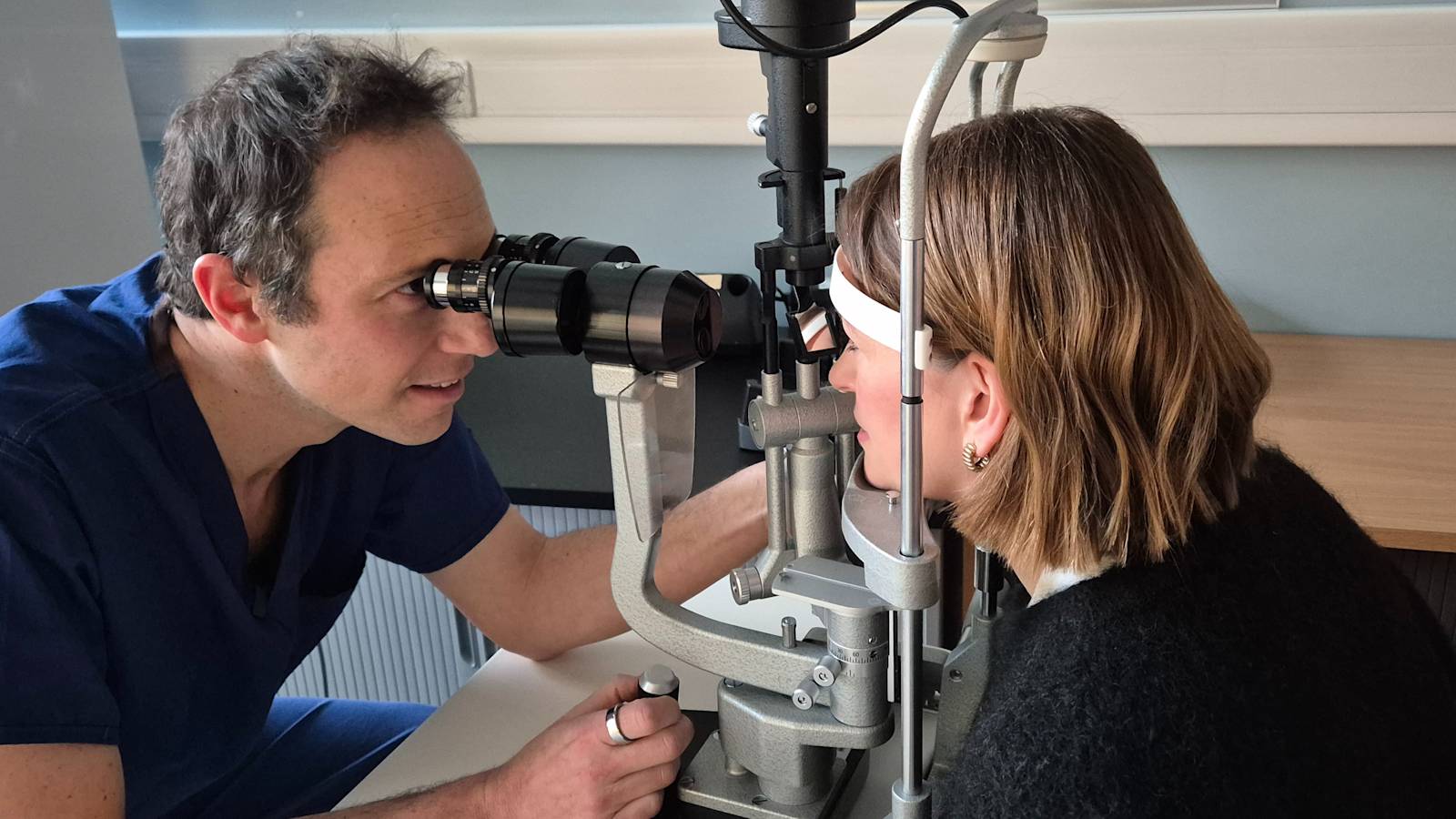
A woman who lost her vision due to a rare condition before having her sight restored with injections that pumped up her eye has described the treatment as “phenomenal”.
Nicki Guy suffers from hypotony, and was the first patient to have her eye injected with a low-cost gel used in most surgeries, as part of a project led by experts at Moorfields Eye Hospital in London.
The rare eye condition can cause blindness, and had previously been thought to be untreatable. The condition affects about 100 people in the UK each year, causing abnormally low pressure in the eye that alters its shape
But the new process, which restores pressure in the eye to improve vision, is “not dissimilar to cosmetic fillers”, specialists said.
Ms Guy has since been able to take her son skiing and is hopeful of driving again.
The 47-year-old said: “I’m so close to being able to drive again with my vision in my left eye.
“If it stays like this for the rest of my life, I would just be exceedingly happy. I’ve been able to take my son skiing. I love taking photographs, so I can do that again.
“There are still challenges with my vision as it is but, from where I was, it’s just phenomenal.”
During the study, specialists injected the eyes of hypotony patients with HPMC – hydroxypropyl methylcellulose – a clear and colourless gel.
HPMC is usually used in surgery to maintain the eye’s shape during operations, or to coat its surface for protection and to prevent it from drying out.
Harry Petrushkin, consultant ophthalmologist at Moorfields, told the Press Association: “Everybody who’s ever had eye surgery will have had this gel in or on their eye at some point, but normally that gel is washed off or washed out at the end of surgery.
“We don’t leave it inside the eye, but it’s actually a really safe substance if you are leaving it inside certain people’s eyes, and it allows it to act a bit like a filler. So, in many ways, it’s not dissimilar to cosmetic fillers.
“It fills the space, but in this context, it fills the space with something that’s transparent and see through, and allows you to give a certain amount per patient to fill the eye up to the size it’s supposed to be.
“A bit like if you’re pumping up a ball, you can pump it up to exactly the right size, and then the eye can see much better.”
Hypotony can be caused by “a number of different diseases”, according to Petrushkin, as well as trauma, inflammation or complications after surgery.
He added: “Up till now, there’s really been no useful long-term management plan for it because we’ve had plans, but all of them have had quite a lot of problems.”

The current standard treatment for hypotony has been to fill the affected eye with silicone oil.
However, this can cause toxicity to the eye and is “not great” in the long-term, Petrushkin said.
The research, published in the British Journal of Ophthalmology, included eight patients with hypotony whose eyes were injected with HPMC every couple of weeks.
Experts found that injecting the affected eye with HPMC not only restored its shape but also restored sight in seven patients after 12 months of treatment.
Vision was measured using sight charts, and there have been “no serious side effects to date”, Petrushkin said.
All patients needed regular check-ups during and after treatment and in some patients, injections were able to be stopped after the eye was restored to its normal size.
Moorfields has treated 35 hypotony patients in this way so far and Petrushkin said the “results are holding up”.
He is now applying for funding for a large clinical trial to test different gels.
The goal is to figure out what gel involves injecting patients as few times as possible, he said.
“Ideally, we’d be able to find a product which expands slowly, so that we can inject a bit, but it slowly expands so we’re not having to top it up,” he added.
“We’re working with bioengineers all over the world, but particularly at UCL, to develop products that do that.”
He stressed that this treatment is not a cure for blindness, but could be used on people with other eye conditions.
“This is a treatment which is amazing for people who have visual potential, as in you are capable of good vision, but your eye is currently not letting you achieve that,” he said.
“It’s not a treatment to bring back blindness, where there is no vision at all.”
He added: “My hope would be that as the project develops, and as our knowledge in this area expands – our knowledge is really rudimentary – we understand where we can intervene to stop people from losing vision altogether.”
Follow STV News on WhatsApp
Scan the QR code on your mobile device for all the latest news from around the country