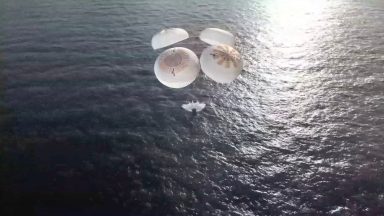
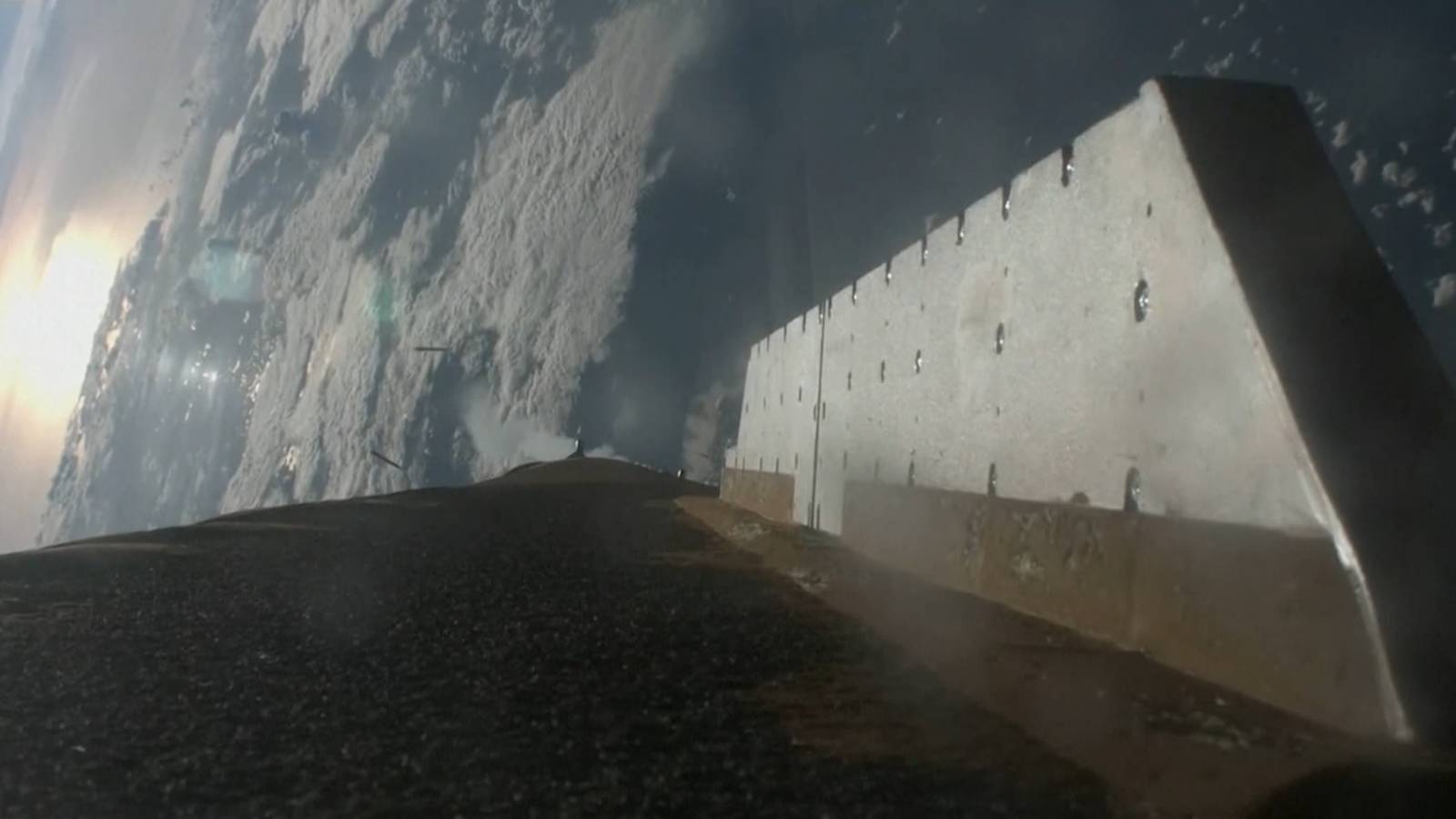
‘We’re going up there for humanity’s future’: ITV News Corresponent Robert Moore speaks to people on the ground by the Kennedy Space Centre as the Orian spacecraft takes off
NASA’s Artemis II crew are orbiting the Earth after setting off on humanity’s first flight to the moon in more than 50 years.
Cheers erupted from crowds at the Kennedy Space Centre in Florida, the US, as the powerful rocket successfully lifted off on Wednesday evening at 23:35pm BST (18:35 EDT).
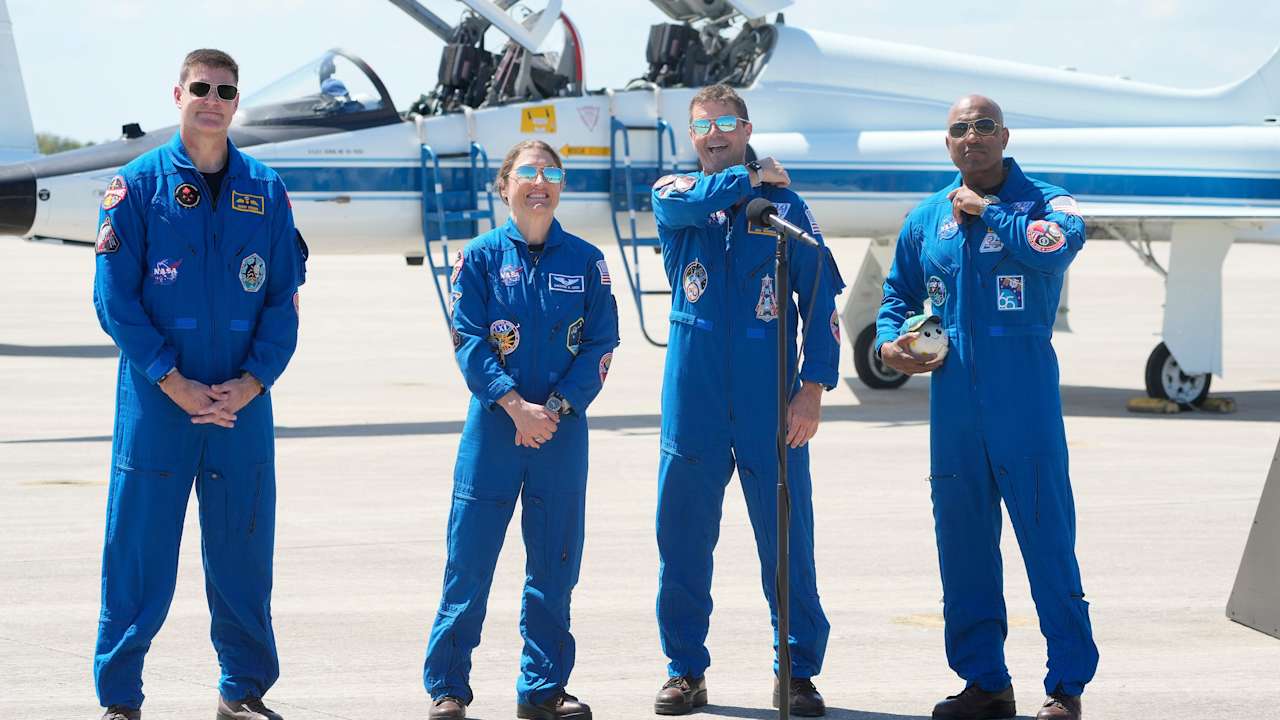
Hurtling into the sky at speeds of more than 26,000 miles per hour were Commander Reid Wiseman, Pilot Victor Glover, and Mission specialists Christina Koch, and Jeremy Hansen.
Five minutes into the mission, Commander Wiseman saw the team’s target: “We have a beautiful moonrise, we’re headed right at it.”
The Orion spacecraft will spend its first 24 hours orbiting the Earth twice while post-launch system checks are carried out.
Watch the NASA Artemis II launch in full
Already within the first hours of flight the aircraft’s only toilet suffered an issue, with the crew reporting a blinking fault light and engineers at mission control scrambling to troubleshoot the problem.
Nasa confirmed the issue had been resolved on Thursday morning.
A valve connected to two water tanks also had to be reset, after it closed when it should have been open.
The first orbit will be in the shape of ellipse and last just over 90 minutes, with the crew travelling at an altitude of about 115 miles by 1,400 miles, according to NASA.
Cryogenic propulsion systems will then push the spacecraft into a longer orbit lasting 23.5 hours and travelling at an altitude of 46,000 miles above Earth, which will allow it to build up enough speed for the eventual push towards the moon.
While still close to Earth, the crew can assess the performance of the life support systems needed to generate breathable air and remove water vapor and carbon dioxide.

The longer orbital period then gives the crew an opportunity to test the systems during exercise periods, where their metabolic rate is at the highest, as well as a chance to rest.
The entire trip is carefully scheduled down to the hour, with the crew’s sleep divided into two four-hour periods during the initial steps of the mission.
NASA has launched a sophisticated Artemis II tracker for anyone wishing to follow the astronaut’s journey to the moon.
The scheduled liftoff time was delayed by around 10 minutes after technical issues involving the rocket’s flight-termination system and one of the craft’s batteries.
Before boarding the astrovan for the nine-mile ride to the launch pad, the astronauts waved and shaped their hands into hearts as they emerged from crew quarters and said goodbye to their families.

Wiseman thanked the crowds that had who gathered to see them off, calling out: “It’s a great day for us. It’s a great day for this team.”
The astronauts then rode a lift up to the capsule and signed their names to the so-called white room.
NASA chief Jared Isaacman had pizza delivered to the launch team in Cape Canaveral, who had spent the morning loading the rocket with more than 700,000 gallons of fuel.
To their relief, no significant leaks occurred, after dangerous hydrogen leaks erupted during a countdown test earlier this year, forcing a delay to the mission.
President Donald Trump has said the US is “winning in space” as he posted on Truth Social ahead of the launch. He said: “For the first time in over 50 YEARS, America is going back to the Moon! Artemis II, among the most powerful rockets ever built, is launching our Brave Astronauts farther into Deep Space than any human has EVER gone.
“We are WINNING, in Space, on Earth, and everywhere in between — Economically, Militarily, and now, BEYOND THE STARS. Nobody comes close! America doesn’t just compete, we DOMINATE, and the whole World is watching.”
The mission, which has cost $93bn (around £70bn) so far, will send the astronauts on a lunar fly-around, meaning they will hurtle several thousand miles beyond the moon, make a U-turn and then come straight back, in a mission lasting ten days.
The crew chose the name “integrity” for their Orion spacecraft, they say to symbolise NASA’s core values of trust, respect, candour and humanity.
King Charles III wrote to Canadian Space Agency astronaut Colonel Hansen to send his best wishes.
“As you embark on this momentous endeavour, I send you and your fellow crew members my heartfelt good wishes. May the stars align in your favour and may your safe return inspire countless others,” he said.
The test flight is part of NASA’s longer term plans, which hope to send more people to walk on the moon, after a number of practice missions. NASA also says this mission is the “next step in the journey to Mars”.
Posting on X, NASA Administrator Jared Isaacman said: “The next era of exploration begins.”
The Artemis II crew may behold never-before-seen regions of the lunar far side — with the moon appearing the size of a basketball at arm’s length during the closest part of the roughly six-hour flyby.
In preparation, the crew have been looking at maps and satellite images of the lunar far side and will carry latest smartphones and professional camera on the mission to take a number of images.
The Artemis astronauts’ lunar mentor NASA geologist Kelsey Young, who will monitor the flyby from Mission Control in Houston, said: “The moon is like such a unifying thing. What we’re doing with this mission is going to bring that a little closer to everybody around the world.”
Launch day was originally planned for February, but was delayed due to bad weather, and later due to a liquid hydrogen leak.
Astronauts last flew to the moon during Apollo 17 in 1972.
Follow STV News on WhatsApp
Scan the QR code on your mobile device for all the latest news from around the country