 PA Media
Israeli strikes on Lebanon following the US-Iran ceasefire deal are “wrong” and “should stop”, Prime Minister Sir Keir Starmer has said during a trip to Gulf nations.
Israel’s bombardment of Beirut is imperilling the two-week truce agreed to by US President Donald Trump after he had threatened that “a whole civilisation will die tonight” – language Sir Keir said he would personally “never use”.
The Prime Minister also said the UK is “monitoring” the use of UK bases by Washington to ensure they are only being used for collective self-defence rather than for offensive operations against Iran.
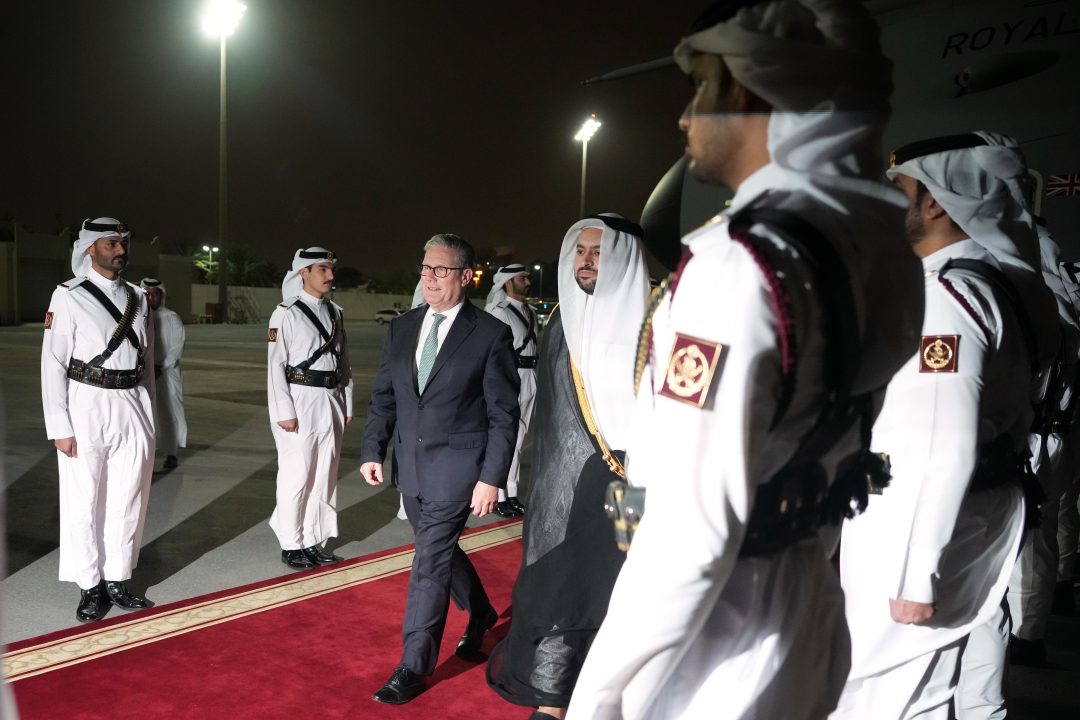
The Prime Minister arrived in Bahrain on Thursday afternoon as part of a trip to the region, which also included stops in Saudi Arabia and the United Arab Emirates, amid signs the ceasefire is already under strain.
Israeli attacks on the Hezbollah militant group made Wednesday the deadliest day in Lebanon since the conflict started, amid disagreement over whether the country was included in the ceasefire.
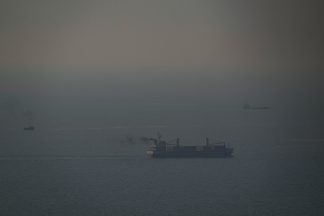
Tehran closed the key oil shipping channel the Strait of Hormuz again in response to the Israeli strikes.
The Prime Minister said it was “hard to say” whether the strikes were a breach of the ceasefire between the US and Iran.
“We haven’t all got access to all the details of the ceasefire,” Sir Keir told ITV’s Talking Politics podcast in Bahrain.
“But look, let me be really clear about it – they’re wrong.”
Asked whether Israel was “wrong to be attacking in Lebanon now”, the Prime Minister replied: “Yes, that shouldn’t be happening.
“That should stop – that’s my strong view – and therefore, the question isn’t a technical one of whether it’s a breach of the agreement or not.
“The (question) is actually a matter of principles as far as I am concerned and, in a sense, my argument would be it should be included in a ceasefire and that’s the important part of the overall approach.”
Ships passing through the Strait of Hormuz must have “toll-free navigation” as part of the ceasefire, the Prime Minister also told the podcast.
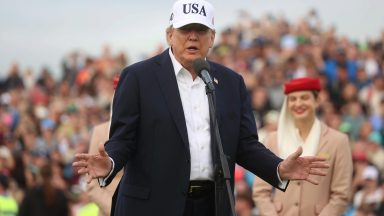
The Prime Minister also faced questions about the UK-US relationship, after Mr Trump mocked him over his refusal to be drawn into the conflict.
In a video from a private Easter White House lunch, Mr Trump impersonated the Prime Minister as he recounted saying he had to ask the UK to send “two old broken-down aircraft carriers” to the Middle East.
The US president has also posted to his Truth Social platform during the war, at one point ending a post “praise be to Allah” and in another warning that “a whole civilisation will die” if Tehran failed to meet his demands.
“Let me be really clear and blunt about this – they’re not words I would use or would ever use because I come at this with our British values and principles foremost and uppermost in my mind,” Sir Keir said.
“I would never use those words and language like that myself – very important that I’m clear that the United Kingdom, we have our principles, we have our values, we will be guided by them.”
He added: “I’ve been saying we are not going to be dragged into this war because I say there must be a lawful basis – that matters.
“If you’re going to commit our service personnel to risk their lives, they need to know they’re doing so on a lawful basis.
“It’s not a question of remote international law – these are real people who take risks with their lives on our behalf.
“They need to know that what they’re doing is lawful.
“I owe them that, and I will never give up on that.
“Secondly, there must be a viable thought-through plan, and absent those two things, then it is not in our national interest to get involved, and we won’t.”
The Prime Minister also said: “I’m saying I’ve been really clear about the use of the bases for collective self-defence only and we are monitoring.”
He continued: “From the get-go we’ve been monitoring this situation, so I’m pretty clear in my own mind about what we’ve agreed and what the use of the bases are, and that is a really important point of principle because we have to learn the lessons of Iraq.
“We need to be clear where we stand as a country and I’m the British Prime Minister, I make decisions on what’s in the British national interest – and that is my focus.”
Elsewhere, Sir Keir wrote in The Guardian newspaper that “Iran must now become a line in the sand”.
He said: “How we emerge from this crisis will define all of us for a generation.
“And instead of hoping to return to the world of 2008, we will forge a new path for Britain – one that strengthens our energy, our defence and our economic security in a new age.
“Because the reality is the world has changed: no longer do we live in the benign conditions found during the early part of this century. The world today is more volatile and dangerous than at any other point in my lifetime.”
The Prime Minister said the Government’s industrial and child poverty strategies were examples of “doing things differently – thinking about the long-term, and remaking this country so that Britain is prepared for a world where shocks like this are more frequent”.
He met in Bahrain with King Hamad bin Isa Al Khalifa and Crown Prince Salman bin Hamad Al Khalifa.
At Al Sakhir palace, the crown prince said Sir Keir’s visit was a “true reflection of friends standing with friends”, and added: “You come not only with words but with action.”
The Prime Minister replied that it was “important to stand with allies”.
Follow STV News on WhatsApp
Scan the QR code on your mobile device for all the latest news from around the country