When the US and Israel attacked Iran six months ago, economists warned the conflict could make the food we eat more expensive to grow, make, package, transport and store.
But annual food and drink inflation has actually fallen, to just 1.3% in July.
Fierce competition between supermarkets has helped keep a lid on prices. And while the market price of energy jumped after the conflict began, gas and oil prices later eased.
But the food industry doesn’t think this will last.
Back in April, the Food and Drink Federation (FDF) warned food inflation would likely hit 9 or 10% by Christmas.
It now thinks the rise will be much smaller and much later. Its latest forecast has inflation at 3.9% in December, before peaking at 6.4% next July.
Karen Betts, chief executive of the Food and Drink Federation, speaks to ITV News
“Food prices are going to rise and by the middle of next year, a family food bill that might have cost them £100 a week in 2020 could cost as much as £150 a week,” says Karen Betts, chief executive of the FDF.
There’s plenty of upward pressure on food inflation. Five heatwaves and drought have battered this year’s harvest in Britain.
Crops in France, Italy and Spain have also been hit by the heat and water shortages. Meanwhile, El Niño threatens harvests of cocoa, coffee, sugar and rice around the world.
In the Gulf, the conflict has escalated again. The US and Iran are both firing on commercial shipping.
Oil and gas prices are climbing again, driving the pump price of petrol and diesel higher.
Russia and Ukraine have spent the last month attacking each other’s ships and ports in the Black Sea – threatening another important route for wheat and grain exports.
“Shoppers are fed up and companies are responding, but this range of inflationary pressures is really too great for companies to be able to do this on their own,” says Betts. “I think really government has got to play a role now.”
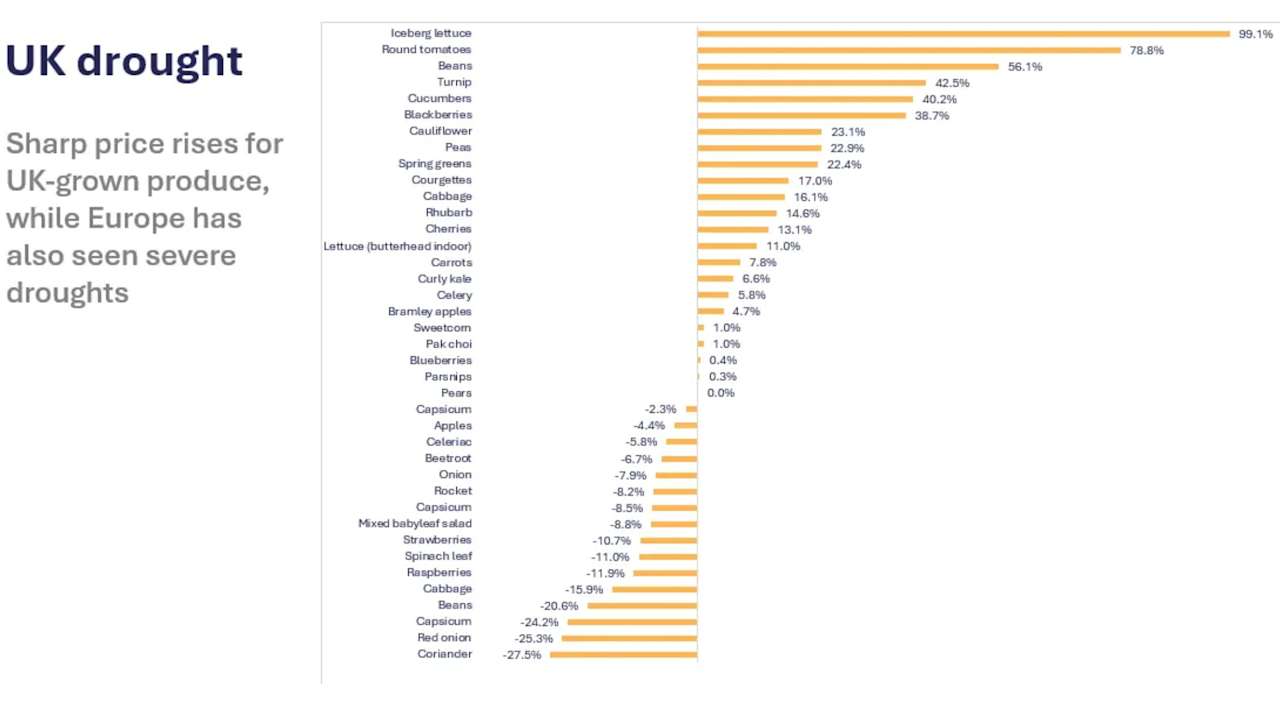
The drought in the UK has affected the price of home-grown fruit and vegetables very differently – depending on where and when crops were produced and whether imports were available.
According to the FDF, iceberg lettuces and tomatoes are almost twice the price they were last summer. Spinach, raspberries and red onions are actually cheaper.
Government policy has also nudged up supermarket prices. The FDF says higher National Insurance and new packaging and recycling rules have added around £2 billion to the annual cost of producing food.
The industry wants the chancellor, John Healey, to subsidise the electricity bills of food manufacturers in his Budget next month and make changes to regulations to help contain price rises.
“A huge driver of inflation at the moment is the government’s packaging and recycling reforms. If government was just to slow those down, to rationalise them, to make them coherent, they could absolutely take some of the heat out of food prices,” said Betts.
Not so long ago, food inflation in the UK was low and remarkably stable.
The pandemic and Russia’s invasion of Ukraine changed all that.
If the FDF’s forecast comes to pass – and there’s no guarantee it will – 6.4% is still a long way below the 19% peak three years ago. But it will still hurt.
Follow STV News on WhatsApp
Scan the QR code on your mobile device for all the latest news from around the country