
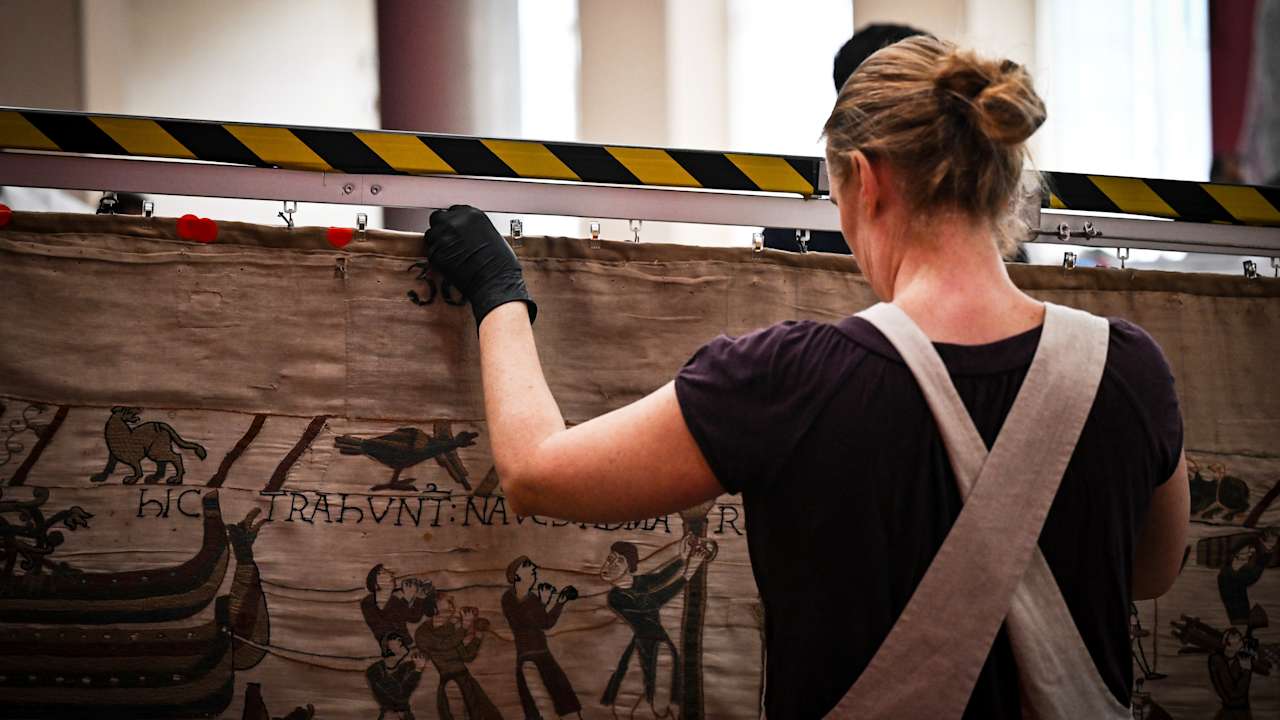
After almost 1,000 years, the Bayeux Tapestry is back on English soil following a high-security nighttime delivery to the British Museum across the Channel that was shrouded in secrecy.
In scenes like a heist movie in reverse, the priceless Medieval artwork was taken to the museum in the dead of night, after a high-tech, tight-security operation.
The artwork is on loan from France and will go on display from September 10 until next July.
Among the most famous artworks on the planet, the enormous tapestry records the 1066 Norman invasion of England by William the Conqueror.
“It feels extraordinary that after so much work and planning and care and thought that it’s actually happening,” British Museum Director Nicholas Cullinan said as he awaited the artwork’s arrival.

“It’s the first time in 1,000 years that such an important piece of British — French too — history is going to be on these shores,” he said. “It’s incredibly exciting.”
The 70-metre tapestry was folded accordion-style in a climate-controlled case that was placed inside a shock-absorbing cradle. That went into a lorry that crossed from France through the Channel Tunnel.
After an 11-hour, 350-mile trip, escorted by police, the lorry backed slowly into a loading bay at the museum, where workers gingerly eased the container, the size of a small car, to the ground. Museum staff and British and French diplomats broke into applause.
The priceless cargo will spend several days acclimatising before it is carefully unpacked and unfolded for an exhibition that the museum expects to be one of the most popular in its history.
About 100,000 tickets were sold on their first day on sale this month.
“It was like trying to get tickets to Glastonbury,” Cullinan said. “I don’t take for granted that people care that much about a 1,000-year-old embroidery. I think that’s an amazing thing.”
Stitched in wool thread on linen fabric, the artwork depicts the events leading up to the Battle of Hastings in October 1066, when William, Duke of Normandy, defeated King Harald’s Anglo-Saxon army. The invasion ended Saxon rule and made William the Conqueror the first Norman king of England.
Historians believe the tapestry was commissioned by Bishop Odo of Bayeux, William’s half-brother, and was probably sewn by women in England — possibly nuns — before being taken across the Channel.
It has spent most of the last millennium in the town of Bayeux in northwest France, apart from two short periods at the Louvre in Paris.
The loan was secured during a state visit to the UK by French President Emmanuel Macron in July and coincides with a renovation of the museum where it normally resides in Bayeux.
In an article published in The Times on Friday, the French president said the loan was a “tangible expression of long-standing friendship and a sign of our shared desire to see France and the United Kingdom build their future together”.
He said the two nations recognise what sets each other apart, but also “their natural affinity and what they can achieve when they join forces”.
“This is what our partnership must continue to embody,” he said. “The UK is a strategic partner, ally and friend of France.”
On X, he posted a picture of the White Cliffs of Dover illuminated with the word Merci and art from the tapestry.
He said, “Long live the Entente Cordiale,” in reference to the pivotal alliance signed between France and England in 1904, which shaped both world wars.
In return, the British Museum will loan treasures from the Sutton Hoo hoard — artefacts from a 7th-century Anglo-Saxon ship burial — and other items to museums in Normandy.
Retired British diplomat Peter Ricketts, who helped secure the deal as the UK’s special envoy for the tapestry, said: “It’s an extraordinary mark of friendship and confidence in the UK to entrust this object to us for a year.”
“Macron, when he offered us the tapestry, I think he understood that it would have far more impact in the UK than it does in France, because it’s more fundamental to our national story,” he said. Everybody (in Britain) knows 1066.”
It features 627 people and 737 animals and tells its story in 58 scenes brimming with vivid and sometimes gory detail. There are scenes of hand-to-hand combat, mutilated bodies and Harold, felled by an arrow through his eye.
“It has an emotional richness that is really difficult to get from written sources,” said Millie Horton-Insch, project curator for the British Museum exhibition.
“It just brings people closer to this history than any other object can. It’s not the same as reading a text. You are looking at something that was handled by the people who lived through it and felt compelled to record these events in this way. “
She said the document’s survival for ten centuries despite myriad dangers — “moths, mice, mould, damp, fire” — is miraculous and may be partly due to its humble materials.
“It’s not really made of any blingy fabric,” she said. “It’s not gold, it’s not silver. There wasn’t the same temptation to cut it up and make it into vestments or repurpose it for anything.”
Some French cultural figures opposed the loan, arguing that moving the tapestry was too risky. Cullinan said the expert teams went to great lengths to ensure its safety, including making two trial runs of the journey to show it would not cause the fragile item too much stress.
Follow STV News on WhatsApp
Scan the QR code on your mobile device for all the latest news from around the country