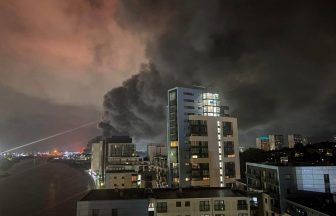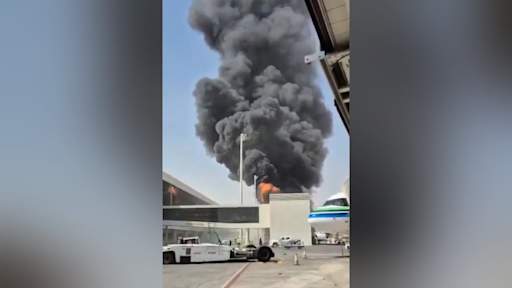
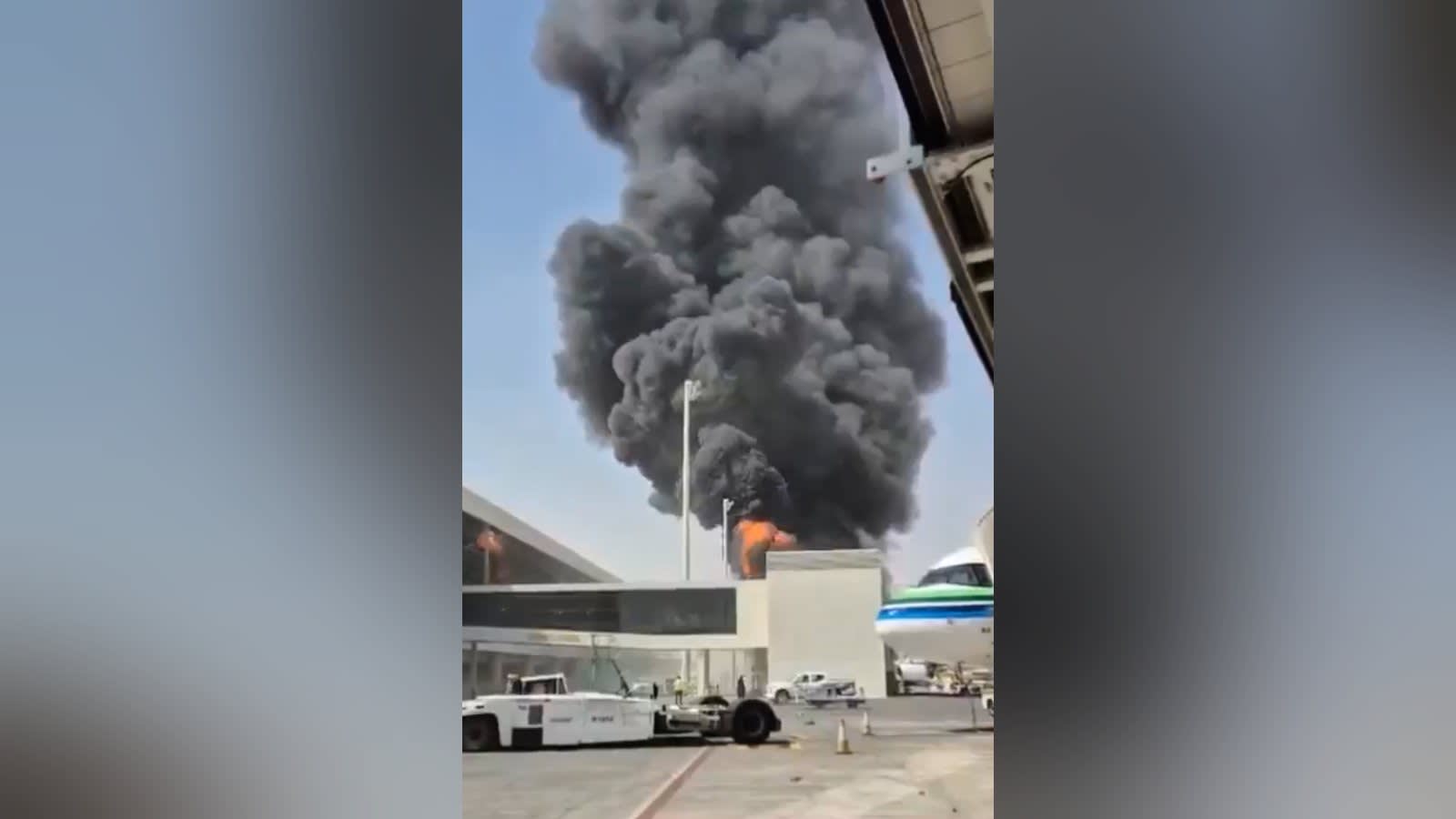
At least 12 people have been killed and more than 300 injured in an attack on the international airport in Saudi Arabia’s capital, Riyadh, local authorities say.
A missile struck a complex at King Khalid International Airport housing terminals 3 and 4 early on Sunday, which serve domestic flights, a regional official said.
The official spoke on condition of anonymity because they were not authorised to speak to the media.
The Saudi-led coalition blamed Iran-backed Houthi rebels in neighbouring Yemen for the attack.
Those killed included four Saudi citizens, two Bangladeshi nationals, a Palestinian, a US citizen, an Egyptian, a Jordanian, a Syrian and a Sudanese national, Saudi authorities said.
The injured were being treated at several hospitals.
Footage posted on social media following the attack and analysed by The Associated Press showed emergency vehicles outside the airport.
Saudi civil aviation authorities suspended airport operations on Saturday. The closure was later extended by 24 hours until 9pm on Sunday, according to flight-tracking platform Flightradar24.
Trump says he will consider joining strikes against rebels.
The strike was the deadliest attack on a Gulf Arab country since the start of the Iran war.
The conflict’s fronts have expanded to include a recent surge in fighting between the Houthis and Saudi-backed Yemeni government forces.
The attack, one of several targeting the airport in the past week, is expected to increase pressure on Saudi Arabia’s allies, including the US, to provide military support.
Riyadh has seemingly tried to avoid an all-out war with the Houthis.
Defence Secretary Wes Streeting called the attack a “dangerous escalation” by the Houthi rebels.
Streeting told Sky News: “What we’ve seen overnight is a dangerous escalation and I’m afraid an increasing pattern of behaviour from the Houthis that’s targeting civilian sites in Saudi Arabia.
“This is completely contemptible action and it’s one of the reasons why the UK is providing support to Saudi Arabia in the form of air defences, but also air-to-air refuelling.
“We want to see an end to this conflict. It cannot be right that the Houthis are attacking civilian targets in this way.”
The UK is not looking at getting involved in offensive operations in Saudi Arabia, he added.
Shortly after the attack on Saturday afternoon, US President Donald Trump said he was considering whether the US should join Saudi strikes against the rebels.

“We may. We’re going to look at it,” he said. “We just found out about the recent attack. So we’ll make a decision. We move very quickly.”
Later on Saturday, Trump said he planned to speak to Crown Prince Mohammed bin Salman, adding that “what happened in Saudi Arabia is not acceptable”.
Asked whether the US might become involved, Trump replied: “We’ll find out.”
US Secretary of State Marco Rubio confirmed in a social media post that an American citizen had been killed in the attack, which he condemned.
“These reprehensible attacks demonstrate a blatant disregard for innocent civilian life. They must stop now,” he said.
The Saudi-led coalition fighting the Houthis blamed the rebels for the strike, describing it as a “fully-fledged war crime” and vowed to respond. The airport has no military facilities.
The Houthis had not issued an immediate statement.
Earlier on Saturday, they accused Saudi Arabia of striking Sanaa International Airport in the Houthi-controlled Yemeni capital.
The rebels claimed responsibility for attacks earlier in the week on King Khalid International Airport that killed three Saudis, including a pilot.
The surge in attacks, including strikes on other Saudi airports, military facilities and oil infrastructure, has come in the week since a Saudi-led coalition launched a major military offensive against the Houthis.
The airport had a heavy police presence on Saturday, with all entrances blocked and lights around the complex dimmed. Flights were diverted elsewhere, Flightradar24 said.
Countries including the US, Britain, Germany, Australia and Canada warned their citizens to avoid the airport.
Also on Saturday, US Central Command said a fighter jet had struck and disabled a commercial cargo vessel in the Gulf of Oman using a precision munition, as part of US efforts to maintain a naval blockade of Iranian ports.
The Panama-flagged M/V Ocean Molica had departed an Iranian port and ignored repeated warnings, CENTCOM said. The ship’s crew was unharmed.
For Iran, the fighting puts pressure on a key US ally
The attacks on Saudi Arabia, the world’s largest oil exporter, have rattled markets and the wider region. However, hours after the latest strike, the Saudi energy ministry was still promoting a major international energy conference due to begin in Riyadh on Sunday.
Until recently, the Houthis had remained largely on the sidelines of the Iran war. Their involvement now gives Tehran another way to put pressure on a key US ally.
Saudi Arabia and the Houthis began fighting in 2015, when the kingdom intervened in Yemen’s civil war in support of the internationally recognised government.

Relative calm following a 2022 ceasefire ended in July, when the Houthis resumed attacks.
The rebels said Saudi Arabia had struck Sanaa airport as a plane from Iran was attempting to land. The incident revived anger over the Saudi-led blockade, which has largely isolated Houthi-controlled areas.
The fighting has since escalated, with the Saudi-led coalition providing air support to Yemeni government forces seeking to reverse recent Houthi gains along the Red Sea.
Those gains gave the rebels improved surveillance capabilities over shipping along a corridor that serves as a crucial alternative to the Strait of Hormuz, where Iran has been attacking ships.
The Houthis have said they are targeting Saudi shipping as part of a blockade in retaliation for the one imposed on them.
However, concerns remain over the risk of wider attacks.
The rebels previously attacked dozens of ships after the war in Gaza began, saying they were acting in solidarity with Palestinians. A US bombing campaign sharply curtailed those attacks.
Saudi Arabia is also running low on missile interceptors and has asked France, Britain, Pakistan and Egypt to deploy air defence support to the region, regional officials said last month.
One official noted that the US had also seen its own stocks dwindle during the war with Iran.
Officials have said US assistance has included intelligence sharing, target identification and planning for the latest offensive against the Houthis.
On Saturday, Saudi Arabia said its foreign minister had spoken by phone with his Omani counterpart about the importance of “supporting diplomatic solutions to de-escalate tensions” in the region.
Oman, which lies across the Strait of Hormuz from Iran, has at times played a mediating role in regional conflicts.
Saudi flight disruptions grow
Earlier this week, the Houthis warned global airlines “for the last time” about the potential consequences of operating in Saudi airspace, which they described as a theatre for their military operations.
Before the latest attack, Air India, FlyDubai, Lufthansa Group and Pakistan International Airlines were among the carriers to suspend flights to and from Riyadh and other Saudi airports for varying periods.
The European Union Aviation Safety Agency had expanded its guidance on Saudi airspace, citing the Houthis’ ability to strike targets deeper inside the kingdom, including Riyadh, and a “greater focus on aviation infrastructure”.
The missile and drone attacks, along with interception efforts, “create an increased risk of misidentification of civil aircraft”, it said.
Follow STV News on WhatsApp
Scan the QR code on your mobile device for all the latest news from around the country