The mega-tsunami, triggered by a mountainside collapsing into the South Sawyer Glacier last August, has been revealed as the second-largest ever recorded, as ITV News’ Vicki Smith reports
A wave as high as the world’s second-highest building tore through the landscape around the Tracy Arm fjord, ripping out trees and hurling millions of tonnes of rock in its path.
Incredibly, no people or ships were nearby, despite Tracy Arm, a narrow fjord lined with steep mountains, waterfalls and glaciers, being a popular tourist destination.
In the months since, a team of scientists from the US, Canada and Europe has been studying the mega-wave, attempting to reconstruct what one researcher called a “hazard cascade.” Their findings were published this week in the journal Science.
Such was the scale of the Tracy Arm wave, which took just 45 seconds to a minute to wreak its destruction — the mountainside that slid off to produce the skyscraper-size wave alone was more than 3,200 feet tall — higher than the world’s tallest building, even scientists were in awe.
The force of the tsunami was so great that it generated seismic vibrations that rippled across the planet, as energy continued sloshing around the fjord for days after the initial collapse.
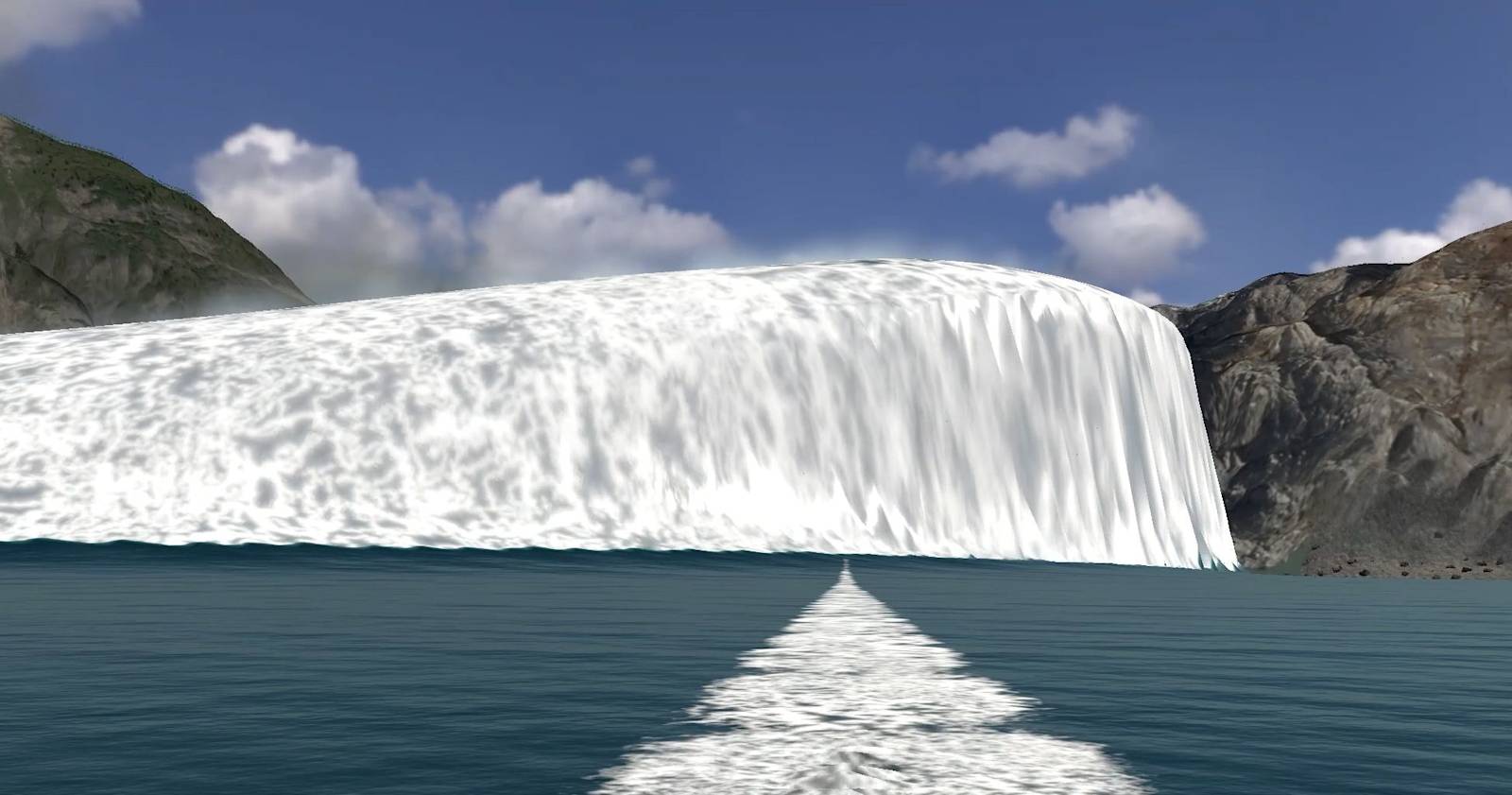
Even scientists used to natural phenomena were in awe of this mega-wave’s power. To better understand and communicate its scale, scientists have recreated the event in a video game.
Tsunami researcher Patrick Lynett said immersing people in a virtual version of the disaster helps them grasp its true magnitude.
“If you can have them experience that disaster digitally, they will recall it as something close to the real event,” Lynett said. “It’s much better than reading about it.”
The video game shows the perspective of the landslide and tsunami wave from the point of view of someone riding a jet ski trying to outrun a towering wall of water before quickly being overwhelmed by it.

Landslides are not uncommon in the Tracy Arm region, but scientists say climate change is increasing both their frequency and intensity.
As glaciers retreat and ice melts, previously stable terrain is becoming increasingly unstable that had been covered for centuries, triggering events such as the Aslankan tsunami.
“As the climate is changing, as glaciers are retreating, we are likely going to see more of these kinds of events in high latitude environments in the Arctic and the sub-Arctic,” Shugar said.
For researchers, the goal is not just to understand what happened, but to reduce the dangers, particularly for coastal communities and tourists visiting Alaska’s fjords.
“As engineers, we can build things really strong, and we can make them survive the events,” he said. “It’s not just how strong you can build things, it’s really training people how to understand and react.”
Scientists are also trying to determine why these massive landslides are becoming more common. Every piece of new information can help them try to reduce the risk going forward, when the next one strikes, Daniel Shugar, a geomorphologist and professor at the University of Calgary, said.

“I certainly hope that we don’t get a repeat event this summer, but it’s entirely possible,” he said. “As hazard scientists, as disaster scientists, we want to minimize the risk to people and infrastructure from these events.”
Alaska-based researcher Bretwood Higman says the trend is concerning.
“When we look back over the last couple 100 years, we see one of these happening about every 20 years,” said Higman, co-founder and executive director of nonprofit Ground Truth Alaska. But in the second-to-last decade, that number had increased to two, and in the last decade it was six such events.
“We have what seems to be a tenfold increase,” Higman said. Despite the results being based on limited data, he said, “I think that pattern is real.”
In addition to informing the cruise industry, other marine vessels, and policymakers, scientists say they hope a virtual jet ski will improve public awareness that these events are even happening.
“We can never remove the risk of something calamitous happening,” Shugar said. “I think that the onus is not just on the cruise ship industries or the policymakers, but also on the individual citizens” to understand the potential dangers involved with a cruise ship trip or a backpacking expedition in the rugged wilderness near receding glaciers and sloping mountains.
These areas, he said, are “never going to be risk-free.”
Follow STV News on WhatsApp
Scan the QR code on your mobile device for all the latest news from around the country