 STV News
Domestic abuse campaigners have called for greater use of location-tracking technology to monitor people considered a high risk to their partners following the murder of a woman in Renfrewshire.
Stacy Hunter was found dead by emergency services in the Corsliehill Road area of Houston, Renfrewshire, on July 27.
The body of the 35-year-old’s estranged husband, Jim Mair, was also found at the scene.
Mair, 43, had been previously charged with assaulting Ms Hunter, but had been granted bail on condition that he did not approach her.
‘Stacy should be alive’
Campaigners are now calling for Scotland to make greater use of GPS electronic monitoring for domestic abuse perpetrators considered to pose a significant risk to a partner, former partner or their children.
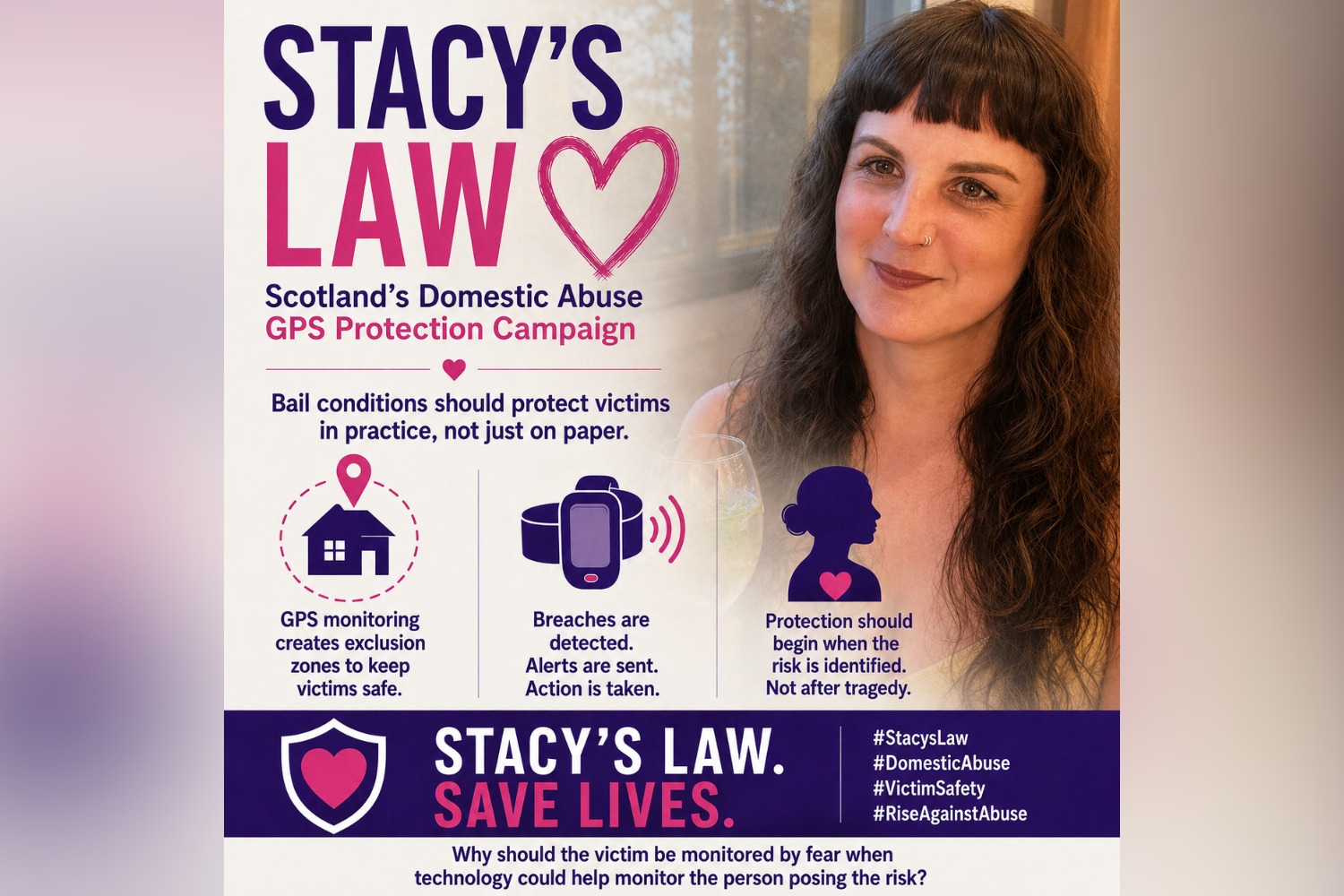
The Stacy’s Law campaign, started by Lynne Mackenzie, says the proposal would not mean automatically tagging everyone accused of domestic abuse.
It argues that GPS monitoring should be proportionate, evidence-based and subject to appropriate judicial safeguards.
What is Stacy’s Law calling for?
- Technology that could alert authorities when a monitored suspect approaches a protected victim or location
- Greater use of GPS electronic monitoring for high-risk domestic abuse perpetrators released on bail or licence
- Individually assessed exclusion zones around victims’ homes, workplaces and other important locations
- Clear alerts and a rapid police response when monitoring conditions are breached
- Stronger consequences for deliberate breaches of bail or licence conditions
- Specialist domestic abuse risk assessments to be considered when decisions about bail and electronic monitoring are made
- Ensuring victims’ safety and views are taken into account when monitoring decisions are made
 Supplied
The campaign said in its petition: “Why should the victim be monitored by fear when technology could help monitor the person posing the risk?
“Stacy should be alive.
“We cannot change what happened to her. But we can ask difficult questions, demand that lessons are learned and campaign for every reasonable protection available to prevent another woman or family experiencing the same devastating loss.
“Protection should not begin after a woman has been killed. It should begin when the risk is identified.”
In Scotland, electronic monitoring has traditionally relied on radio frequency (RF) tags, which are primarily used to enforce curfews and restrictions on where someone can stay.
The technology works by connecting a tag to a receiver installed at an offender’s home, meaning it cannot monitor their movements when they leave the property.
Community Justice Scotland (CJS), an independent public body, has previously called for the system to be modernised. Last year, it issued an urgent recommendation to the Scottish Government to speed up the introduction of more advanced forms of electronic monitoring.
CJS raised concerns that GPS and alcohol monitoring technology had still not been introduced in Scotland, despite an expert group recommending their use in 2016.
GPS monitoring has been used in England and Wales since 2018, with further measures, including new restriction zones for offenders, also being introduced.
It comes after new statistics revealed that the number of domestic abuse incidents reported in Scotland has increased 81% in the past four years, and 19% in the past 12 months, with 3,264 reports made in the year to June.
The data also revealed a 9% rise in sexual crimes in a single year, 13% higher than the year ending June 2022.
The number of rapes and attempted rapes reported in Scotland has risen by almost one third in four years.
Victims minister Kirsten Oswald said the government would consider the calls for greater use of electronic monitoring.
She said: “My thoughts continue to be with the family and friends of Stacy Hunter following their terrible loss.
“We are listening carefully to victims and support organisations about what more can be done to prevent and tackle violence against women and girls and we will carefully consider the petition. The First Minister has pledged his personal leadership on tackling the scourge of violence against women and girls.
“As the First Minister has made clear, Government has a vital role to play in tackling violence against women and girls, but lasting change requires all of us to play our part. Men, in particular, must challenge sexism, confront abusive behaviour and help create a culture where every woman and girl can live free from violence, abuse and fear.
“While decisions on bail and remand are always a matter for the independent court, bail can be electronically monitored.”
Follow STV News on WhatsApp
Scan the QR code on your mobile device for all the latest news from around the country