 Adobe Stock
Viewing events are set to take place across Scotland as stargazers gather to witness a rare partial solar eclipse – but forecasters have warned the event is likely to be hidden behind clouds in many areas.
The extremely rare event will occur when the moon passes directly in front of the sun, plunging Scotland into near-darkness for a brief time.
If you miss this one, you’ll need to wait until 2081 for the next, or 2090 for the next total eclipse.
What you’ll see
More than 90% of the sun will be obscured by the moon between about 6pm and 8.15pm on August 12, the most it has been blocked above UK skies since the total eclipse in 1999.
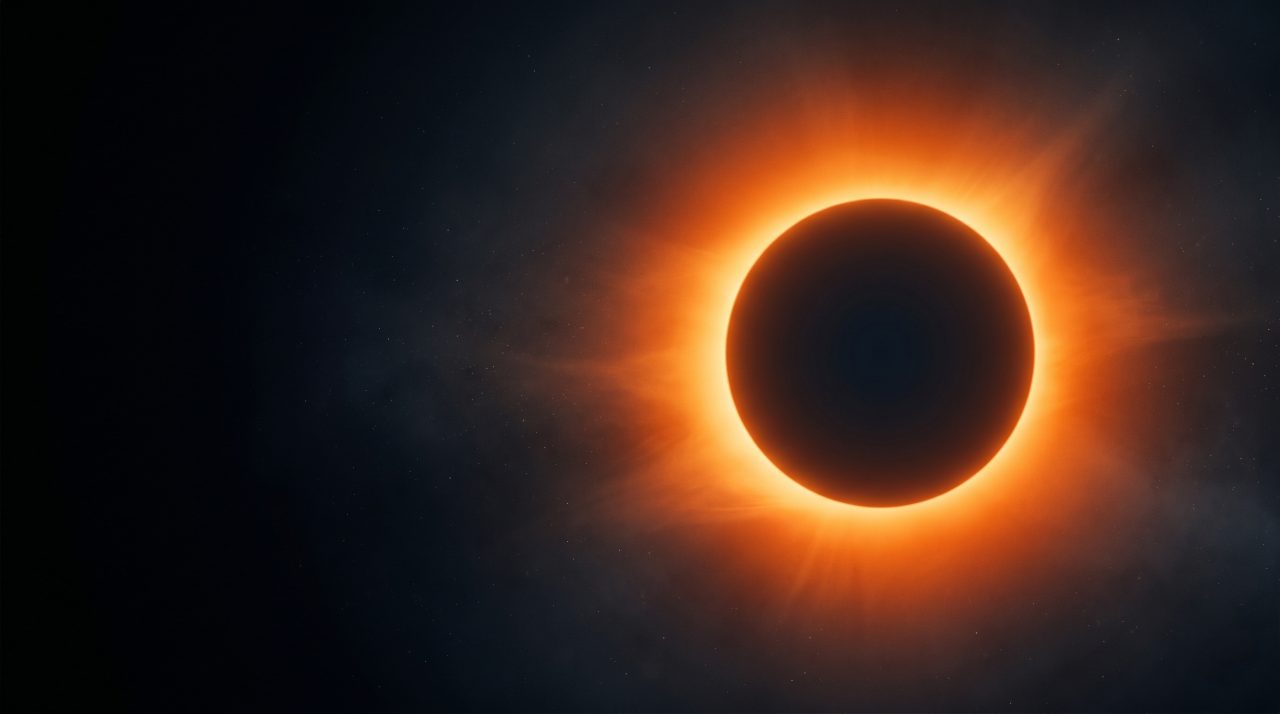
The eclipse will peak at around 7pm when only a small arc of the sun will still be visible on the top.
The moon will then continue to drift across the left of the sun, before clearing it shortly after 8pm.
It is expected to be the fullest eclipse over local skies until 2081.
Where to watch
The Met Office has identified the west of Scotland as the best location to view the eclipse, with the best coverage expected just after 7pm.
The moon will obscure more than 90% of the sun, the most it has been blocked above UK skies since the total eclipse in 1999.
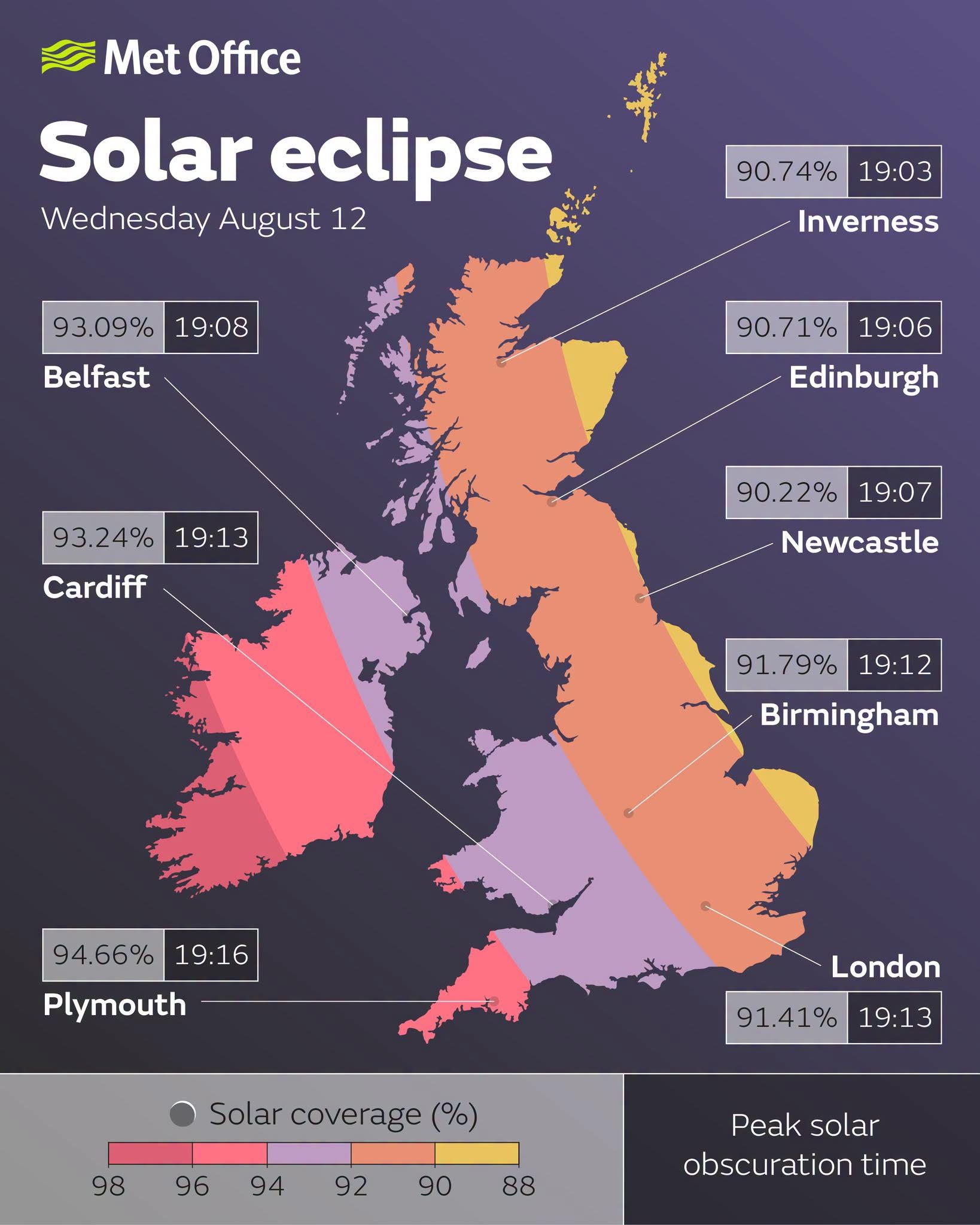
Those living in Inverness will likely see the moon obscure 90.74% of the sun at 7.03pm, and in Edinburgh, 90.71% of the sun will be hidden at 7.06pm.
Aberdeenshire, Orkney and the Shetland Islands will only see 88% to 90% of solar coverage.
Those living on the Western Isles and along the west coast will see between 92% to 94% of the sun obscured; however, visibility may be difficult due to cloud cover.
On the east coast, the sky will be clearer.



However, in a blow to stargazers, forecasters have warned the rare event is likely to be hidden behind clouds for many, but that it may be visible in some areas.
The Met Office said eastern areas such as Aberdeenshire, Angus and Moray are most likely to have clear skies when the rare event takes place.
The forecaster said there may also be breaks in cloud cover in the central belt and southern Scotland.
 Met Office
Overall, Majorca and southern Spain are the best places to watch the spectacle.
The area will be plunged into complete darkness with the moon completely obscuring the sun.
The Royal Astronomical Society will host visitors at the observatory on Calton Hill in Edinburgh, where stargazers will be given free eclipse glasses and be able to look through a solar telescope.
Other events in the south of the country include at the Red Burn Farm in Glasgow and the Dark Space Planetarium in Kirkcudbright.
Viewing events further north include the Tomintoul Skyhide Stargazing Pavilion in Ballindalloch and Mosstowie Primary School in Elgin.
There are also events planned on some of Scotland’s islands, including at Midhowe Broch Car Park, Rousay, Orkney, and at Ardminish on the Isle of Gigha.
How to watch safely
Can I use sunglasses to watch the eclipse?
No, it is not safe to watch the eclipse using regular sunglasses. Only specialised eclipse glasses are safe to use.
According to the National Aeronautics and Space Administration (NASA), eclipse glasses are several thousand times darker than sunglasses, meaning they are safe for viewing the Sun.
If you have a pair of eclipse glasses, NASA recommends inspecting them for damage before using and discarding the goggles if torn or scratched.
The organisation also says you should not use eclipse glasses while looking through binoculars, camera lenses, or any other optical device, as the concentrated solar rays will burn through the glasses’ filter and could cause eye injuries.
What do I do if I cannot find eclipse glasses?
With so many looking to view the eclipse, glasses are in short supply.
The Royal Greenwich Observatory has completely sold out of eclipse glasses while a viral social media clip from Tuesday evening showed queues around the block at one of the few remaining stores in London stocking the items.
If eclipse glasses are not available, Nasa suggests using indirect viewing methods. These do not involve looking directly at the sun, but instead project the eclipse onto a nearby surface.
For example, a pinhole projector can be made using a box, aluminium foil and a white sheet of paper. By taping foil and paper to both ends of the box, then punching a hole in the foil, you can indirectly view the sun shining through the hole onto the paper.
During the different phases of the eclipse, you will be able to see the shadow from the Moon block out the light projected onto the piece of paper.
If you do not have time to make a pinhole projector, Nasa suggests a good alternative is using a colander. By watching the shadow that the colander projects onto the ground, you can safely view the phases of the eclipse.
Can I use my phone’s camera to view the eclipse?
While using your phone’s front-facing camera to view the eclipse will not damage your eyes, it could destroy your device.
In a post on X, NASA said that pointing your phone’s camera directly at the sun could damage its image sensor.
The organisation added that using magnifying lenses attached to the phone camera would increase the risk of damage.
NASA suggested using a solar filter or holding a pair of eclipse glasses in front of your phone’s lens to protect the sensor from damage.
Why is it dangerous to look at the sun during an eclipse?
Normally, when we glance at the sun, the brightness prevents us from looking too long and damaging our eyes with solar radiation.
However, while eclipses might appear less bright, the UK Health Security Agency explains that solar radiation is just as dangerous as during any other day.
This leads to people being mistaken that it is safe to look at the sun during an eclipse.
Follow STV News on WhatsApp
Scan the QR code on your mobile device for all the latest news from around the country