 STV News
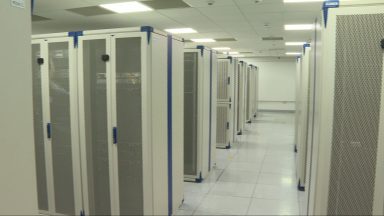
Rapid expansion of hyperscale data centres could “stress Scotland’s electricity system” without co-ordinated planning, a report has warned.
The Scottish Enterprise paper also highlighted “clear tensions between hyperscale’s massive energy demands and Scottish sustainability goals”.
It found most of the employment in data centres is “concentrated in the temporary construction phase”, and that direct onsite staffing is “relatively light touch and modest”.
The report, by the Frazer-Nash Consultancy, was commissioned to look at the “opportunities and challenges” presented by data centres.
Campaigners against new hyperscale data centres said the document’s publication had been delayed.
The report is dated from May, but Dr Kat Jones of Action to Protect Rural Scotland said it had not previously been made public.
She said: “For a research paper on a subject of such public interest it is a surprise that this document, which was published back in May, and circulating among civil servants as early as March, was not made public previously and that, now it is live, it has not been accompanied by any kind of publicity from the Government.”
She added: “A Government agency commissioned a report all about the economic benefits of hyperscale data centres and they couldn’t come back with a single one.
“In fact, it confirms a number of points of concern that we have been raising with the Government for months – that jobs are limited in data centres, that wider supply chain and economic benefits are limited, and that hyperscale data centres present a risk to Scotland’s already-strained energy system.”
Noting that campaigners had been raising “concerns exactly like those revealed in this report”, she claimed ministers had been aware of the report since March but had “ignored our asks to be heard”, describing this as a “kick in the teeth”.
Amanda Grimm, of Stop Climate Chaos Scotland, said: “It’s no wonder that publication of this damning report was delayed.
“It confirms communities’ fears and adds to the case that hyperscale data centres are a threat to Scotland’s energy system.”
The report said Scotland has “up to 20-25 proposals for hyperscale data centres at various stages of development”, pointing out that the country’s “abundant renewable energy sources can support cheaper, greener data centre developments”.
But it warned: “Rapid hyperscale expansion could stress Scotland’s electricity system without co-ordinated planning, data transparency and targeted mitigations.”
It added: “Utility companies are concerned that they cannot quickly connect multiple large power demands to parts of the electricity grid that are already under rising pressure.”
The report found: “The unique problem for hyperscale data centres is balancing their resource use and local impacts with the opportunity they present to contribute to Scotland’s digital economy and strategic position within the global digital infrastructure landscape.”
But is said for local economies the “direct value is limited” if such centres have imported hardware, resulting in procurement that “bypasses local supply chains”.
To tackle this, it recommended Scotland develop its own supply chain for construction, grid services, operations and maintenance.
To “maximise regional benefit for Scotland” it also suggested data centres could have local workforce targets, and seek to re-use some of the heat generated by the centres.
Ms Grimm said: “The question now is what the Scottish Government will do in response.
“Will they continue seeking ‘responsible green data centre investment’, an oxymoron on two fronts? Or will they listen to the report researchers, the expert witnesses who have spoken to the Scottish Parliament, and communities who continue to sound the alarm?
“Stop Climate Chaos Scotland is calling on the Scottish Government to hold a full public consultation on whether Scotland wants and needs hyperscale data centres.”
A Scottish Government spokesperson said: “The Scottish Government will be publishing new planning guidance on data centres before the end of the year and, in parallel, is developing a strategic approach to maximise the economic and public benefit from data centre investment in Scotland.
“Planning authorities are also now required to notify ministers of new data centre applications, with a new planning direction also mandating an Environmental Impact Assessment (EIA) to be submitted during planning for all new data centres with a power capacity exceeding 50 megawatts (MW).”
A spokesperson for Scottish Enterprise said: “This report was published in full on our website in line with our usual procedures.
“Scottish Enterprise’s role is to drive sustainable, responsible economic growth in Scotland.
“We routinely publish impartial economic commentary and research, and this report follows this principle.”
Follow STV News on WhatsApp
Scan the QR code on your mobile device for all the latest news from around the country