
The number of hate crime charges in Scotland has surged to a record high.
Official figures show that 7,115 hate crimes were recorded in 2025-26, an increase of 17% and the highest number recorded since the introduction of the act in 2003.
Race hate crimes remain the most commonly reported, featuring in 56% of all charges.
In total, 3,990 charges relating to race crime were reported in the last year – an increase of 17% compared to the previous year. This is the highest since 2013-14.
The number of hate crimes aggravated by sexual orientation has risen by 20%, from 1,719 to 2,062.
Watch
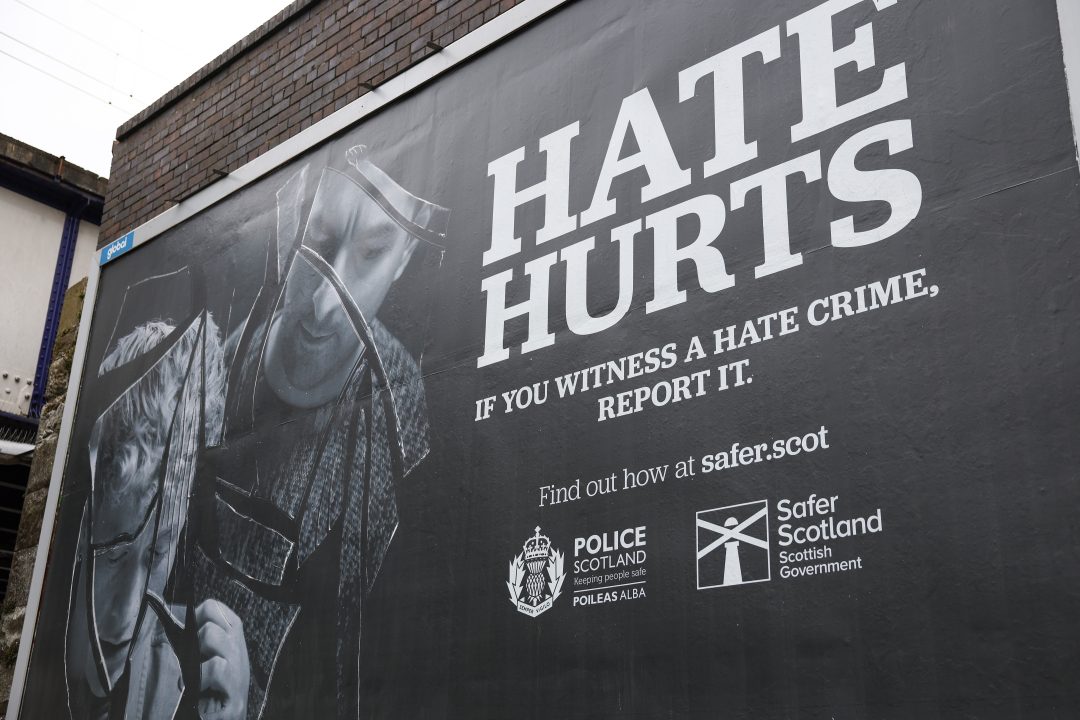
Police Scotland’s Hate Monster Campaign
This is the highest number of sexual orientation crime charges reported since the aggravation came into force in 2010.
There was a 25% increase in disability aggravated crime, from 1,099 to 1,370, and religious hate crimes rose by 5.1%, with 537 charges across the year.
There were 104 recorded hate crimes against transgender people, compared with 86 reported in 2024-25.
This is also the highest number of such charges since this legislation came into force in 2010.
Newly appointed Lord Advocate, Ruth Charteris KC, said the increase in reports of hate crime should “concern us all”.
“Everyone who lives in Scotland is entitled to feel safe and every hate crime represents a decision to target a person because of who they are,” she said.
“I want to reach out to communities across Scotland and say that prosecutors are here to ensure that every report of a crime motivated by hate will be carefully considered and brought before the court where appropriate.
“That commitment is reflected in our response to reports of hate crime. Last year, 94% of charges resulted in prosecutorial action, while only 2% of all hate crime charges reported resulted in no prosecutorial action.
“We each have a role to play in challenging the actions of those who are motivated by prejudice and hate. Today’s publication highlights that prosecutors remain focused on holding offenders to account, helping to ensure Scotland is a place where everyone can live free from the threat of hatred or abuse.”
Victims and community safety minister Kirsten Oswald said: “Recent events have highlighted increased levels of intimidation, and we know the impact this has had on communities who may already be feeling vulnerable.
“These latest figures show that hate crime remains a serious issue in Scotland and this government stands firmly against any form of hatred, prejudice or intolerance and the rhetoric which underpins it.
“Everyone deserves to live free from harm, and no one in Scotland should fear being targeted because of who they are.
“While it is essential that people feel empowered to report incidents of hate crime – and this increase may partly reflect improved reporting and awareness – each case represents real harm to individuals and communities.
“We stand united with Police Scotland, the Crown Office and Procurator Fiscal Service, and community partners to prevent hate crime, support victims, and improve data and understanding.”
What is considered a hate crime under the new law?
The Hate Crime and Public Order Act came into force in 2024 and updated the law covering the stirring up of racial hatred, and extended that protection to other groups.
Those protected characteristics are disability, religion, sexual orientation, age, transgender identity and variations in sex characteristics.
However, unlike the 1986 UK law, people must intend to stir up hatred against the other groups.
In the UK, a hate crime can be committed against a person on the grounds of race, even if the person did not intend to stir up hatred.
Under the new law, to be found guilty of a hate crime, two tests must be met.
- A person must engage in behaviour or communication that is perceived by a reasonable person to be threatening or abusive on the grounds of disability, religion, sexual orientation, age, transgender identity or variations in sex characteristics.
- A person must intend to stir up hatred on the basis of these protected characteristics.
The law applies to behaviour and speech made both in public and in private, such as in a person’s home.
Chief Superintendent Joanne McEwan said: “The impact of hate crime can have a significant long-lasting impact on individuals and instigate fear within entire communities.
“Our primary focus is to improve the safety and wellbeing of people, localities and communities across Scotland.
“We are working ever closer with our partners and stakeholders to encourage reporting, support victims and bring offenders to justice. Anyone who engages in hate crime will be dealt with swiftly and robustly.
“We are taking a victim-centred approach to improving our third-party reporting processes, understanding that removing barriers can encourage those who feel most vulnerable to report and enable appropriate support measures to be put in place.
“We are also working with our partners to ensure communities in Scotland understand what hate crime is, their rights and what to expect when they report a crime or incident, while also ensuring our third-party reporting centres are equipped and have access to training to best support victims and signpost appropriately.
“Together we can work towards a Scotland where everyone can live, work, and thrive, free from the threat of harm caused by hostility and prejudice.”
Follow STV News on WhatsApp
Scan the QR code on your mobile device for all the latest news from around the country