 Getty Images
An expose has revealed what undercover journalists found after a year inside Reform UK.
In among swathes of racist and sexist comments – most of which came from party activists but in some cases went as high up as elected councillors – the key takeaway was that the party’s attempts to tighten up its vetting processes simply hadn’t worked.
One memorable scene saw the party’s head of communications Ed Sumner telling a new member of the press team that she would have to start “defending the indefensible” in protecting party representatives from media attacks.
“…these candidates from Wales and Scotland are going to be, in a sense, lambs to the slaughter…”
A number of Reform UK candidates running in the 2024 general election were forced to step down over social media posts ahead of polling day, causing embarrassment to the party leadership and threatening the credibility of the rising force on the right.
After the election, leader Nigel Farage promised to get his party’s vetting processes under control.
Undercover: A Year in Reform, broadcast on STV and available on STV Player, appeared to show prospective candidates heading to media training days in London where they would have to defend controversial online posts in staged phone interviews with Reform UK board member and former GB News commentator Darren Grimes.
The investigation didn’t look at Scotland, but at the time senior Reform officials had advised me that Scottish candidates were subject to rigorous vetting procedures which included local branches choosing people from approved lists, with interviews at Reform’s HQ in London a required part of the process.
But how organised the party was in practice was a different matter.
The Scottish group didn’t have a named leader until earlier this year, announcing former Tory peer Lord Offord as the face of their movement less than six months before the Holyrood election.
This investigation shows that, in the UK party, while attempts were made to crack down on rogue candidates, ultimately the party saw limited success.
Officials explain in the undercover filming that with so many people applying to stand for Reform, some unsavoury individuals would inevitably slip through the net.
But the film revealed that the new strategy was less about cutting out people with controversial views – and more about burying the evidence.
The superficial approach meant that post-vetting, a number of candidates began causing problems for the party on social media.
Reform’s communications officers weren’t impressed – but ultimately, decisions about keeping versus culling problematic candidates went to the top.
Sumner was seen complaining to Farage about the “protecting” of a mayoral candidate who had called for then-Foreign Secretary David Lammy to return to the Caribbean where his “loyalty lies”.
The decision to get rid of people often seemed to come down to how senior they had become in the party or how impressive their CVs were.
If the party’s Westminster list had caused concern, the candidate list for May’s Holyrood and Senedd elections was even more worrisome.
Reform UK had begun to poll well in Wales, with Farage taking his “reindustrialisation” vision to Port Talbot in 2025 when he called for the reopening of the coal mines.
But the party’s performance in Scotland caught even the higher-ups at Reform UK by surprise.
The group had one sole point of contact at the start of 2025 – a new organiser with little staff or resources who had taken over after his predecessor was found to have linked to proscribed terror group the Ulster Volunteer Force (UVF).
But with polling suggesting the party was undergoing a Scottish surge, the race was on to find candidates and staff.
As the Exposure investigation shows, one press officer had his doubts about the quality of the candidates.
“Genuinely, these candidates from Wales and Scotland are going to be, in a sense, lambs to the slaughter,” he said.
“The thing is they’ve literally all just got to delete their Facebooks, as soon as they’re selected, for three or four months. Before they’re announced just delete their social media.”
Luckily for Reform in Scotland, a number of Tory councillors were ready to jump ship, with now-deputy leader Thomas Kerr – the former Conservative leader at Glasgow City Council – one of the highest profile getaways.
The Scottish group weren’t filmed in this investigation but there is some frustration in Holyrood today that one of the most prominent voices in the episode – that of Alan Feeney, who quit as a Reform councillor from two councils over his comments about Asian people – is quite clearly Scottish.
Feeney has never worked in Holyrood, instead serving in Birmingham. There remains concern in Reform’s Scottish group about the calibre not of their politicians, but of their staffers – some of whom have been noted as expressing views that don’t align with the party’s official stances.
That’s not to say the Scottish group hasn’t struggled. On Monday, the party went from being joint second-largest in Holyrood to third place, after losing Amanda Bland, regional MSP for Central Scotland and Lothians West. She now stands as an Independent.
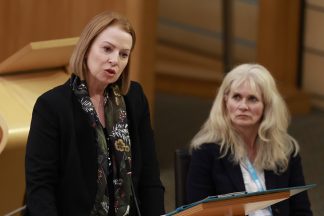


While the timing is notable, coming hours after the release of the investigation, party sources say she left due to internal issues, including the collapse of her office after a member of staff resigned.
She had been expected to attend a meeting with party figures on Wednesday about this. Bland herself put out a statement this afternoon, saying that: “Holding the Scottish Government to account remains a key priority, and I believe I can best pursue these goals as an Independent MSP.”
Reform UK is still riding high in the polls, although it has dropped to second place in many after the election of new Labour Prime Minister Andy Burnham and increasing scrutiny on Farage’s finances.
This investigation is unlikely to turn Reform UK’s core supporters off – indeed, some have taken to social media to praise some of the comments revealed – but it may stem the flow of support from other parties.
Likewise, while Bland’s quitting is a blow for Reform in Scotland, given it makes Scottish Labour the main opposition now, we are unlikely to see this standalone event reverse the party’s fortunes. For that to happen, the “Farage factor” has to take a bigger hit still than this.
Undercover: A Year in Reform is available on STV Player
Follow STV News on WhatsApp
Scan the QR code on your mobile device for all the latest news from around the country