 STV News
An inquiry into the derailment of a train in Aberdeenshire has heard the outcome would “more likely than not” have been better if the train had been built to modern safety standards.
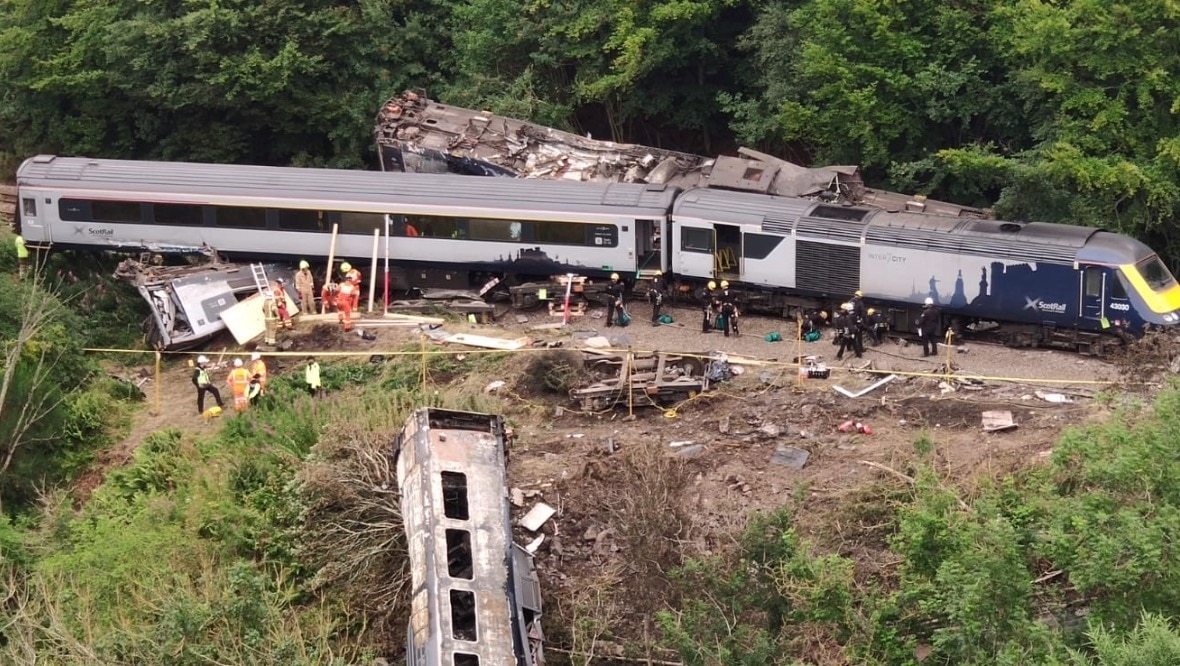
The train crashed at Carmont near Stonehaven on August 12, 2020 after it hit a pile of gravel washed onto the railway track by heavy rain before striking a bridge parapet.
Of the nine people who were aboard the train, three – train driver Brett McCullough, 45; conductor Donald Dinnie, 58; and passenger Christopher Stuchbury, 62 – were killed.
The fatal incident inquiry (FAI) at Aberdeen Sheriff Court heard on Wednesday that the train was made up of Mark 3 high-speed train (HST) coaches, which were built by British Rail in the 1970s.
Dominique Louis, a principal inspector at the Rail Accident Investigation Branch (RAIB), told the inquiry the 50-year-old coaches lacked a number of safety features that are now standard in modern trains.
He told the inquiry: “The RAIB considers it more likely than not that the outcome would have been better if the train had been compliant with modern crashworthiness standards.”
Mr Louis said the coaches were built before the requirement for “anti-climb devices” – which prevent one coach riding over the top of another in the event of a crash – and “energy-absorbing vehicle ends” such as crumple zones.
Had these been in place, he said, they would have reduced the risk of coach D “overriding” the lead power car, which he said caused a “complete loss of survival space” that resulted in the death of Mr Dinnie.
He also said the “couplers” linking the coaches were together less capable than modern designs of withstanding the forces caused by the collision, which resulted in the train breaking up.
“All the vehicles became uncoupled except at the interface of coach A and the trailing power car,” Mr Louis said.
“That allowed the vehicle to scatter and roll over. That increased the risk of secondary impacts.”
Mr Louis also pointed out the coaches lacked devices to ensure they remained attached to their “bogies”, or wheeled chassis, which he said resulted in the five-tonne bogies being free to “slide and roll around in an uncontrolled manner”.
He explained: “Mark three coaches, unlike vehicles designed after 1994, are not fitted with any form of bogie retention in the vertical direction.
“This allowed the vehicle bodies to lift off their bogies during the derailment, and that’s how we ended up with so many bogies scattered around the accident site.”
Taken together, he said, “stronger couplers combined with anti-climbers and energy absorption structures” could have enabled coach D to keep the lead power car on track for long enough to make it over the bridge.
The inquiry also heard that corrosion had been found in a number of areas damaged in the crash, including around the base of pillars in coach D that were sheared off in the collision.
Mr Louis said metallurgical analysis found what should have been 5mm plates of steel had been reduced to 3-3.5mm, despite corrosion repairs having been made to the coach in 2019.
Mr Louis said: “It is undeniable that loss of material due to corrosion of the pillars would have weakened the body-end structure to some extent.”
However, he added: “The investigation was not able to determine whether or not the original strength of the pillars would have been sufficient to prevent the loss of survival space that led to the death of the train’s conductor.”
The inquiry also heard evidence about the two fires that broke out following the collision, in the power car and in coach B, with RAIB inspector Mark Hamilton explaining that since nobody was trapped inside the train, they had not posed a risk to human life.
The FAI was previously told the death toll would have “almost certainly” been higher had the train been full on August 12 2020.
The crash took place during the Covid-19 pandemic, with the Aberdeen area on lockdown, and there was a drop of around 65% in passenger numbers across the entire network at the time, the inquiry heard.
A criminal prosecution saw Network Rail fined £6.7 million in 2023 after it admitted health and safety failings over the crash.
A Network Rail spokesperson said on Monday the Government-owned company is “committed to supporting the work of the inquiry and continuing to deliver on the recommendations made by RAIB”.
They added: “We’ve made significant changes to how we manage the risk of severe weather since the accident, and our work to make our network more resilient will continue.”
The inquiry before Sheriff Lesley Johnson continues.
Follow STV News on WhatsApp
Scan the QR code on your mobile device for all the latest news from around the country