 Dave Braddock via RSPB
A 50% increase in Capercaillie numbers has been recorded at RSPB’s Abernethy nature reserve over the past five years.
The boost in numbers from 20 lekking males in 2021 to 30 in 2025 is a critical lifeline for the population of just over 500 birds.
Capercaillie, a large woodland grouse, are found only in Scotland’s Caledonian pine forests within the UK.
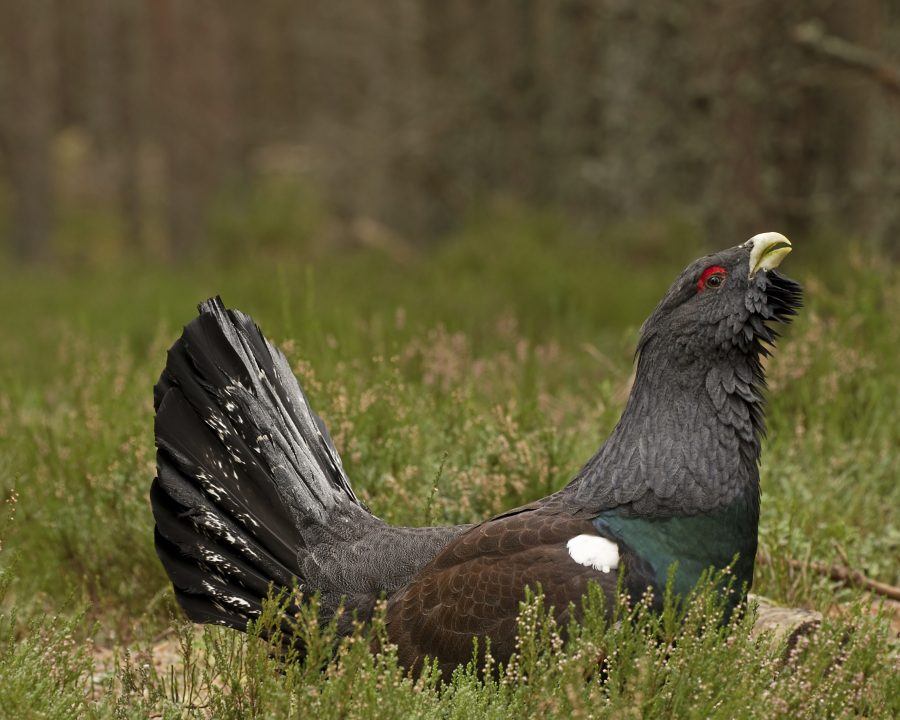
Males are distinctive for their black feathers with a metallic green sheen, fan-shaped tails and a “clip-clop” call during lekking, a courtship display that has earned them the Gaelic name “horse of the woods”.
Females are much smaller and mottled brown, grey and black.
During lekking season, males gather at traditional sites to perform displays of clicks, pops and so-called “flutter jumps” in an effort to attract females.
“Lekking” describes the males’ courtship behaviour where they perform a display of clicks, pops and “flutter jumps” at lek sites.
Richard Mason, conservation manager at RSPB Scotland Abernethy said: “The increase in the number of lekking male Capercaillie is thanks to the huge amount of work we are undertaking to improve habitat quality.
“The combination of cutting and extensive cattle grazing has dramatically improved conditions in the forest. We are seeing many chicks reaching full size and whilst the future of Capercaillie remains in the balance, we are hopeful that these techniques can support their recovery in Scotland.”
Capercaillie numbers have been declining significantly for decades, with the most recent national survey (2021-2022) estimating only 532 remain.
That is the lowest recorded level since surveys began in 1992-1994 and a 52% decline since the previous survey (2015-2016) when the population estimate was 1,114 birds.
Richard added: “There is still a lot of work to be done for Capercaillie, not just at RSPB Abernethy, but across all Capercaillie sites in Scotland. We know that their recovery is only possible by working together and in collaboration with others.
“It is exciting to see that other land managers looking after Capercaillie habitat are also undertaking innovative vegetation management with support from the Scottish Government’s Nature Restoration Fund managed by the Cairngorms National Park Authority.
“By enhancing these native pinewood forests, we can collectively work towards the recovery of this incredible bird.”
Follow STV News on WhatsApp
Scan the QR code on your mobile device for all the latest news from around the country